LokAI
Product Design Case Study
2025
Designing AI
That Knows Its Place
in Indian Law
A guided legal clarity and action system for Indian citizens — and the
honest process of figuring out what that actually means to design.
Role
Product Designer
Origin
Material+ Buildathon — Top 10
Platform
Web + Mobile
Status
Design concept
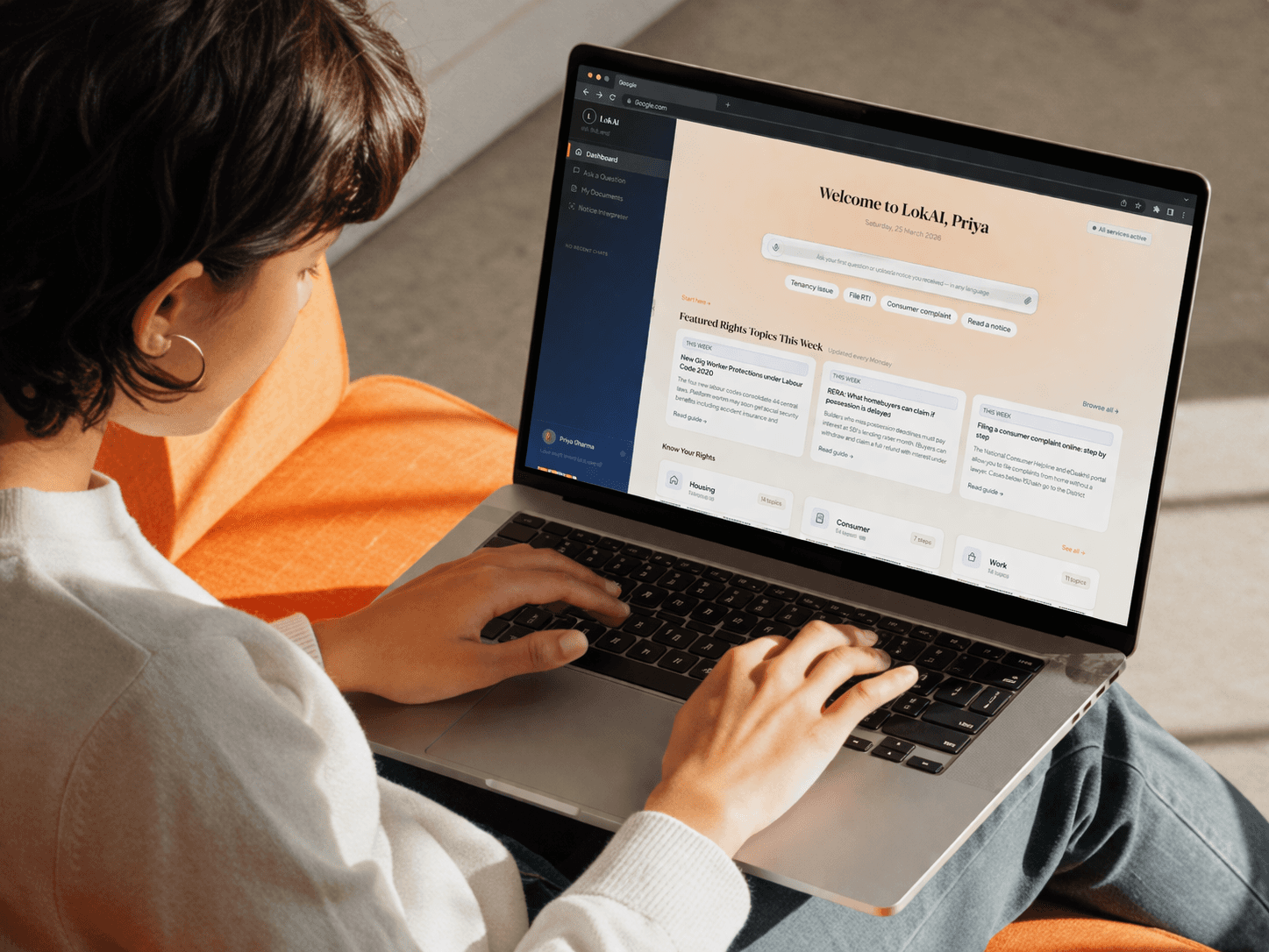
01 — Problem
She got the notice three weeks ago. She still hasn't opened it.
What this section shows:
→ Legal access fails before court
→ The real problem is action, not understanding
Priya, 31, rents a small flat in Andheri. Last month her landlord handed her a printed notice — in Marathi, formal legal language, a reference to some section of an act she's never heard of.
She asked her neighbour. She googled it. She asked her office colleague who "knows a lawyer." She didn't get a lack of answers—she got a lack of actionable ones. Google gave her a dense SEO article about the Maharashtra Rent Control Act. The informal lawyer advice was just, "Send a formal reply."
Okay, but how? Does it need to be on stamp paper? What section should she quote? What if she formats it wrong and accidentally admits fault? The risk of making a mistake feels higher than the risk of doing nothing. So, the notice sits on her kitchen counter. She's been afraid to touch it.
This is not a literacy problem. This is not even a language problem. This is an action problem.
The scale of inaction
Pending cases
5M
+
Cases in consumer courts — not
because people lack legal
standing, but because most
disputes never become formal
filings.
Language barrier
80
%
Of India does not primarily use
English. India's legal system
operates almost entirely in
English.
Free legal aid
NALSA
Provides free legal aid to eligible
citizens. Most have never heard
of it. Access is not the same as
awareness.
The gap between "I know something is wrong" and "I filed something" is where justice gets lost — not in
courts, but in kitchens.
The real problem: For urban Indians in everyday legal disputes with landlords, employers, platforms,
or government bodies — the pathway from knowing you're wronged to formally asserting your rights
is invisible without English proficiency, legal vocabulary, or money.
02 — Users
What do people actually do when they face a legal situation?
Before designing anything, I needed to understand two things: who encounters this problem, and what do they do today that fails them.
Priya Sharma
31 · Andheri, Mumbai · Office administrator
Situation
Received a notice about her
tenancy. Landlord claiming she
owes money she doesn't believe
she owes.
Today
Asks neighbours. Googles vaguely.
Waits. Eventually pays or ignores —
both feel equally risky.
Stuck at
Doesn't know if this is a legal
matter, a landlord bluff, or
something she should have
responded to already.
What fails
Every option gives her more
information. None of them tell her
what to do.
Arjun Krishnan
26 · Coimbatore · Delivery platform worker
Situation
Account deactivated without
explanation. Earning gone. Tamil is
his primary language.
Today
Calls platform support repeatedly.
Gets no resolution. Asks friends if
this has happened to them.
Stuck at
Doesn't know if this is even a legal
issue. "Can I actually do something
about this?" is a question he hasn't
gotten a straight answer to.
What fails
Every available resource is in
English or Hindi. He knows
something is wrong but cannot
formally assert it.
These are not edge cases. These are the majority of Indians who encounter legal friction every week —
and do nothing, because the system that's supposed to protect them doesn't speak to them in a way
they can act on.
03 — The Wrong Assumption
I spent two weeks designing a solution to the wrong problem.
LokAI started as a hackathon idea — the brief was to use generative AI for real social impact. The first framing was: "People don't understand their legal rights because of language barriers."
That's a comprehension problem. The natural solution is better translation, clearer summaries, simpler
language. A legal Wikipedia with multilingual support.
I started designing that. Then I noticed something: the features that felt most valuable were not explanation features. They were action features — document generators, complaint drafts, RTI applications. That's when I stopped.
The question that broke the frame: What do people do when they already understand the problem
but still don't act?
Arjun knows his account was deactivated unfairly. Priya knows the notice feels wrong. Neither of them
lacks understanding. Both of them lack a pathway. The problem was never comprehension. It was the
gap between knowing and doing.
Designing for a comprehension problem produces an information product — something that explains.
Designing for an action barrier produces something entirely different — a system that guides you from
"I know something is wrong" to "I have filed something that creates accountability."
Cases don't fail in court. They fail at the counter — because people never showed up.
04 — Research
Research at a glance:
Sources:
→ Access-to-justice reports, consumer protection data
→ Government portals (RTI, consumer courts)
→ Legal-tech tools and app reviews
Key insights:
→ Most users don’t convert disputes into formal action
→ Legal processes are simple, but feel complex
→ Existing tools explain — they don’t guide action
What desk research actually showed about the problem space.
Because LokAI is a concept project, this research is secondary and desk-based — not field interviews.
That is stated upfront because a production product would require something this case study doesn't
have: conversations with citizens who attempted to file something formal and gave up at a specific
step. That's where the real design problems live.
What desk research can do is validate that the problem space is real, that the gap is structural (not just
anecdotal), and that no existing tool has designed for it correctly. It can also challenge early assumptions — which is exactly what happened here.
Research goals
01
Understand how ordinary Indians currently resolve small legal and consumer disputes — not theoretically,
but what they actually do
02
Identify where in the journey they drop off: awareness of rights, comprehension of the issue, or the action
step itself
03
Map the existing landscape — what tools exist, who they were built for, and what they consistently miss
Methods
Research
source
What I looked at
What it suggested
Access-to-
justice reports
Legal aid utilization, tech in courts, NGO
clinic models
Citizen-facing tools are nearly absent; most
legal tech serves professionals
Consumer
protection data
Complaint filing rates, consumer
awareness workshop focus areas
People rarely file formal complaints despite
having valid grievances
RTI and
consumer law
docs
Filing procedures, statutory timelines,
rights documentation
Process is legally simple; procedural
complexity is a perception problem, not a
legal one
App store
reviews / forums
Reviews of existing legal apps;
Reddit/Quora threads on filing
complaints
Consistent confusion at the same point: "I
know something is wrong — what do I do
now?"
Competitive
landscape
NyayGuru, VakilAI,
consumerhelpline.gov.in, RTI online
portal
Market optimizes for legal professionals;
government portals are form-heavy with no
guidance layer
What the research found
India has strong legal mechanisms. Almost nobody uses them.
The Consumer Protection Act 2019 gives citizens clear redressal rights. Consumer courts carry over 5 million pending cases — not because people lack standing, but because most disputes never reach formal filing. NGO legal aid programs spend the majority of their resource teaching people "how to file," not explaining rights. The gap is at the action step.
The existing digital layer was built for professionals, not citizens.
E-courts, legal databases, and advocate portals dominate. Government complaint channels exist but are procedurally complex — jargon-heavy forms, no plain-language guidance, no clear next step after submission.
The emotional state of a first-time filer was not a design consideration.
The language problem is real, but it is downstream of the action problem.
Over 80% of India does not primarily use English — yet almost every formal legal mechanism operates in English. Solving language without solving action produces a multilingual dead end.
The pivot this research forced: I had been designing an information product — a legal clarification
tool with multilingual support. The research made clear that the problem wasn't understanding.
People were already confused after understanding. The research validated the reframe before the key
insight was locked.
05 — Key Insight
Core shift:
→ People don’t need clarity
→ They need a next step
Understanding ≠ Action.
This is the single insight that restructured every design decision in LokAI.
When Priya reads a clear explanation of her tenancy rights, she feels informed. She does not feel ready
to act. There's a gap between "I understand what the law says" and "I have a document in my hand that
I can submit to create accountability." That gap is filled by: knowing which specific authority to contact,
knowing the correct format of a legal document, knowing that a formal action will be taken seriously,
and believing that the system will respond to someone like her.
Where users drop off — the citizen legal journey
Something feels wrong
Notice received, account
deactivated, money
withheld
Seeks information
Google, neighbours,
colleagues — gets mixed
signals
Understands the
situation
Knows something is
wrong. Has no clear next
step.
Attempts to act
Finds forms, legal
language, unclear
procedures
Most drop here
Files formally
Document submitted,
accountability created
User reaches this step
Primary drop-off point
Rarely reached
Comprehension is a prerequisite. It is not the outcome.
LokAI is not designed to make people understand the law. It is designed to get them to the counter.
This changes what the product prioritises. Not depth of information — clarity of next step. Not
completeness of legal knowledge — a document they can actually file. Not a confident AI — a verifiable
source they can trust.
Every visual decision, every interaction pattern, every piece of copy in LokAI answers the same
question: what does this person need to see right now to take the next step?
06 — Market Reality
The tools exist. The experience doesn't.
The research landscape scan surfaced multiple platforms that had arrived before LokAI — NyayGuru,
JuniorLawyer, VakilAI, LawLens. All multilingual. All capable. All with developer-level UX.
What competitors do well
Multilingual legal information
Comprehensive legal database
Document templates available
Multiple Indian languages supported
What's missing
Designed for anxious users, not curious ones
Clarity over completeness
One clear next action, not a menu of options
Voice-first input for non-typing users
Experience shift:
Current tools: User → reads → confused → stops
LokAI: User → understands → gets action → files
The gap is not features. It's the experience design. These products were built by developers to
demonstrate capability. None of them were built from the user's emotional state outward — the
confusion, the intimidation, the distrust of automated legal advice.
Decision →
Early drafts of the case study treated LokAI as "just another chatbot." I kept pushing back. The
differentiator was never the feature set — it was designing for the emotional state of someone in a legal
situation they don't fully understand. That framing changed everything.
07 — Product Definition
System boundary:
LokAI handles: RTI, complaints, notices
LokAI does NOT: criminal law, court cases
LokAI is not a chatbot. It is a guided decision system.
The distinction matters for design. A chatbot is open-ended — it responds to anything, generates
conversation, treats the interface as a dialogue. A guided decision system has a clear job: take a situation, assess it, produce a clear position, and offer one next action.
Action-first, not information-first
Every response ends with something the user can do,
not just understand
Guided, not open-ended
Defined scope, clearly communicated when something
falls outside it
Clarity over completeness
Show what matters for this situation, not the entire legal
landscape
Multilingual natively
Sarvam AI reasons in the language — Tamil, Bengali,
Marathi — not via English translation
What this determines about the product
The scope is intentionally narrow in v1: RTI applications, consumer complaints, demand notices, and
notice interpretation. These cover the majority of disputes an ordinary citizen can handle without legal
representation. Both have established formats, clear filing procedures, and statutory response timelines that make the system reliable and specific.
Anything outside this scope — criminal law, court proceedings, contested property disputes — is explicitly declined, with specific human pathways offered instead. The boundary is not a limitation. It is the product's integrity.
Why not just use ChatGPT or Gemini directly?
Sarvam is the engine. LokAI is the vehicle designed for a specific road and a specific passenger.
General-purpose LLMs are excellent at exploring ideas. They are unreliable for jurisdiction-specific legal action.
Jurisdiction problem
They hallucinate across legal
systems
A general LLM may cite UK
consumer law in response to an
Indian complaint. It has no
mechanism to constrain itself to
Indian law, RTI formats, or state-
specific rules. The user cannot tell
when this happens.
Emotional design problem
Not designed for anxious users
A generic chat interface puts the
burden of framing and
interpretation on the user. LokAI
handles all three — in the user's
language, with a curated verifiable
source, with one clear next action.
Output structure problem
They produce conversation, not
decisions
ChatGPT returns open-ended text.
LokAI implements a fixed flow:
situation → assessment → legal
position → ready-to-file document
with citations. That structure is a
product layer — not an LLM
capability.
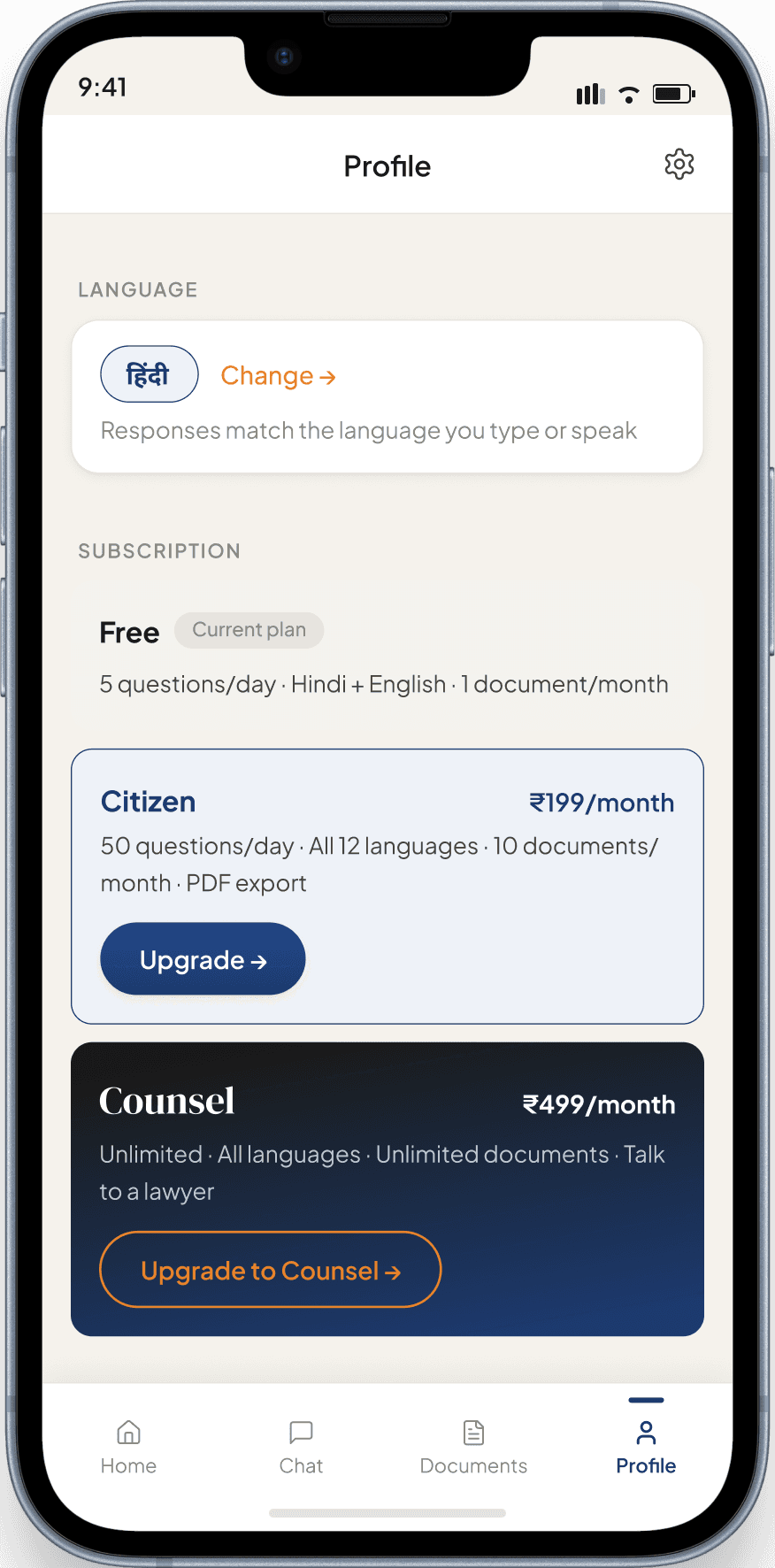
Business Model — Three tiers, one principle
Free (5 questions/day, Hindi + English, 1 document/month) removes the access barrier for first-time users.
Citizen ₹199/month (all 12 languages, 10 documents) serves regular users.
Counsel ₹499/month (unlimited + lawyer access) serves users whose situations escalate beyond self-service.
Each tier answers a different version of the same question: can I afford to know my rights?
11 — Visual Design System
Authority and warmth, calibrated for an anxious user.
LokAI’s visual direction resolves a specific tension: it needs to feel legally authoritative (trustworthy, cited) but also warm and approachable for an anxious citizen. The resolution: Authority through structure (serifs, structured layouts) and warmth through color (earth tones, saffron, terracotta).
The gradient system — semantic, not decorative
Three gradients. Each one used in exactly one context.
Gradient tokens — usage rules
Brand gradient — sidebar header + TL;DR card only
#1A1916 → #1C3A6E · 160deg · Used nowhere else
Response gradient — response card left border + action moments only
#E8832A → #C4620A · 135deg · When you see saffron, something requires your attention
Button gradient — primary buttons only
#22478A → #1C3A6E · 180deg · 2% luminosity difference — adds physical depth to buttons
Typography — hierarchy as a trust signal
The choice to set the main legal finding in large DM Serif Display italic is a trust decision as much as an
aesthetic one. Serif type reads as authoritative — it borrows from the visual grammar of legal
documents, newspapers, official verdicts. The large size signals: this is the thing that matters.
Everything else recedes.
Type scale
DM Serif Display ·
20px · italic
Main legal finding —
response card
मकान मालिक का कोई अधिकार नहीं
Plus Jakarta Sans ·
15px · 400 · lh 1.8
Body — Latin
Under Section 7(1) of the RTI Act, 2005, every public authority must
respond within 30 days.
Plus Jakarta Sans ·
16px · lh 1.9
Body — Devanagari
(+1px +0.2 lh)
RTI अधिनियम 2005 की धारा 7(1) के अनुसार, सूचना 30 दिनों में दी जानी चाहिए।
Plus Jakarta Sans ·
15px · lh 1.9
Body — Tamil (native
render)
வீட்டு உரிமையாளர் deposit திரும்ப தர வேண்டும்.
monospace · 11px ·
500
Citation stamp
RTI Act 2005 · s.7(1)
Note: Devanagari and Tamil glyphs are denser than Latin. Line-height and minimum size are adjusted at the design
token level — not per-screen overrides. This ensures multilingual content is equally readable across all screens without
manual intervention.
Color — earthy, calm, purposeful
Color tokens
Surface
Page bg
#FAFAF8
Card
#FFFFFF
Raised
#F4F2EE
Brand
Navy
#1C3A6E
Navy soft
#EEF2F8
Saffron
#E8832A
Terracotta
#C4724A
Ink
#1A1916
Border
#E8E4DC
Terracotta (#C4724A) is used only for user chat bubbles. The one warm color in the interface reserved for the human
side of the conversation. The navy handles authority. The saffron handles urgency. The terracotta handles warmth.
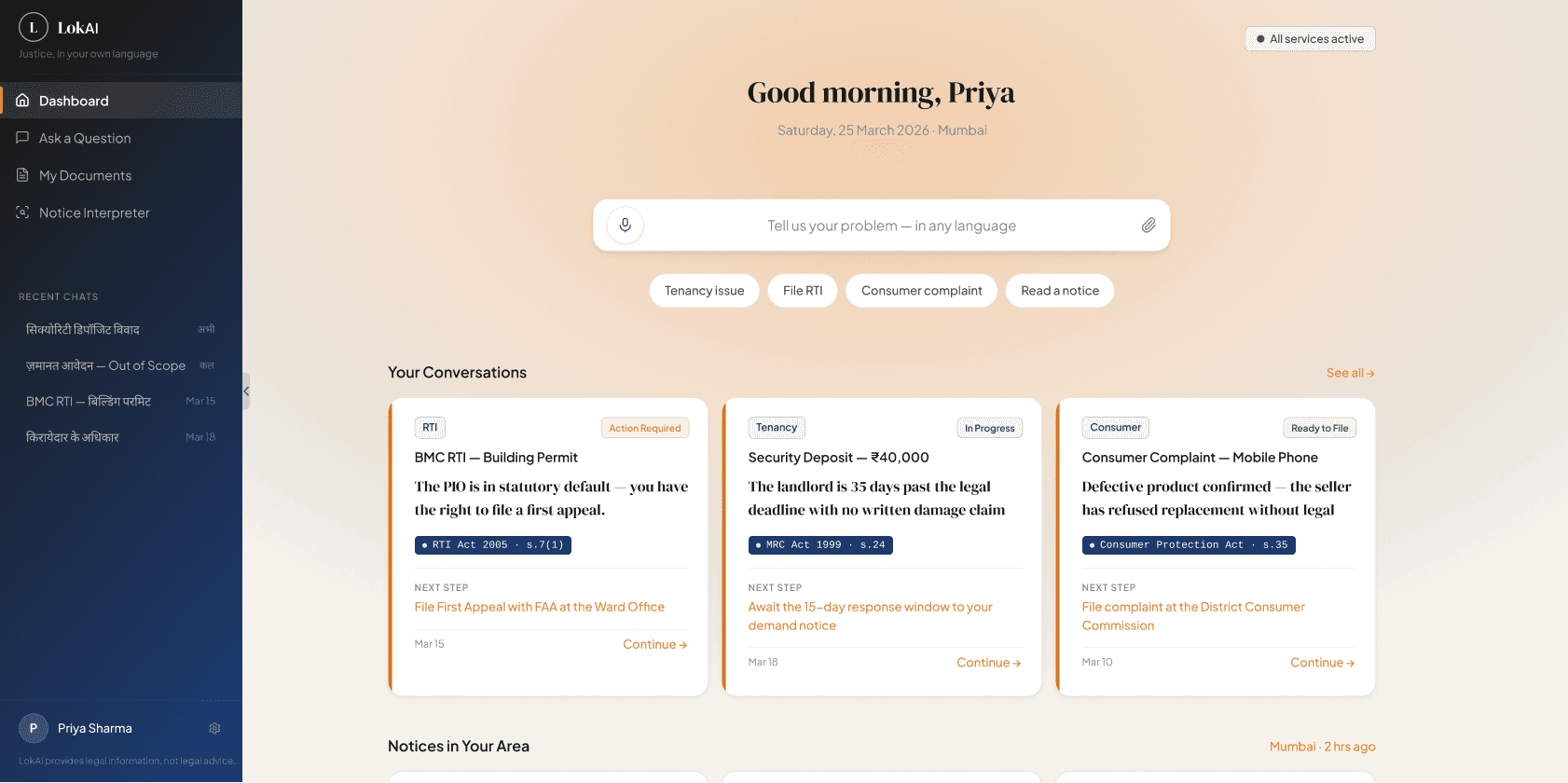
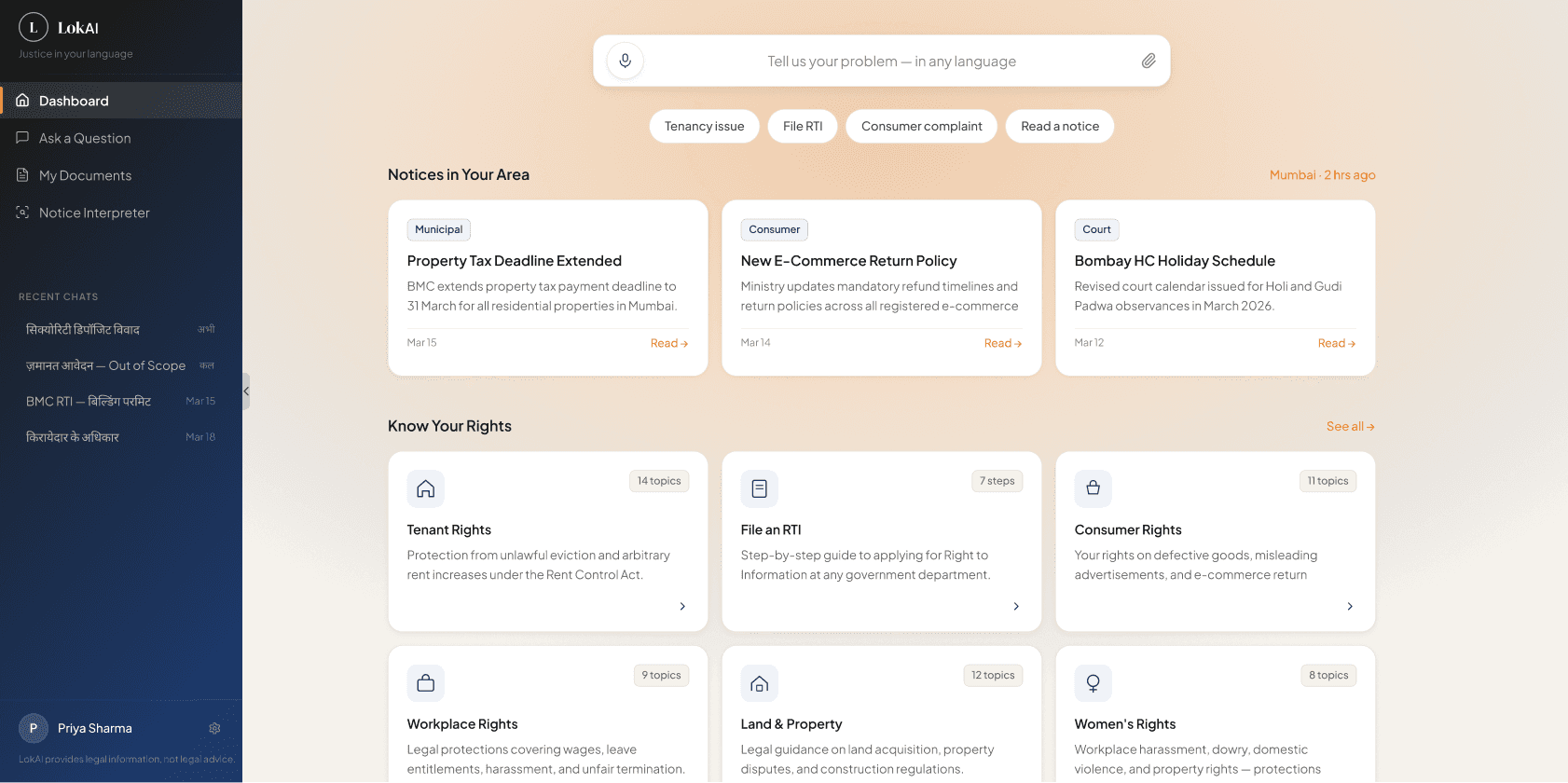
/ Dashboard
Three sections: recent conversations summary (with citation stamps and next action), local government notices, and Know Your Rights.
08 — Core Experience
What this section shows:
→ LokAI is a system, not a chatbot
→ Input → Structure → Action
One flow. Deeply designed.
The most important experience in LokAI is not the dashboard or the document generator. It is the
moment a user describes their situation and receives a structured response that tells them exactly
where they stand.
This flow — input → processing → assessment → action — is the product. Everything else supports it.
User input
Voice / text / photo
—any Indian language
Language detection
Sarvam STT / OCR
— native, not translated
Legal
knowledge
retrieval
Curated DB —
IndiaCode, India
Kanoon, CIC
Structured
output
Structured
response card +
citation stamp +
one action
The model retrieves from a curated, versioned database — never from the open internet. Every legal claim carries the
source tag it was retrieved with. That's where citations come from: retrieved, not generated.
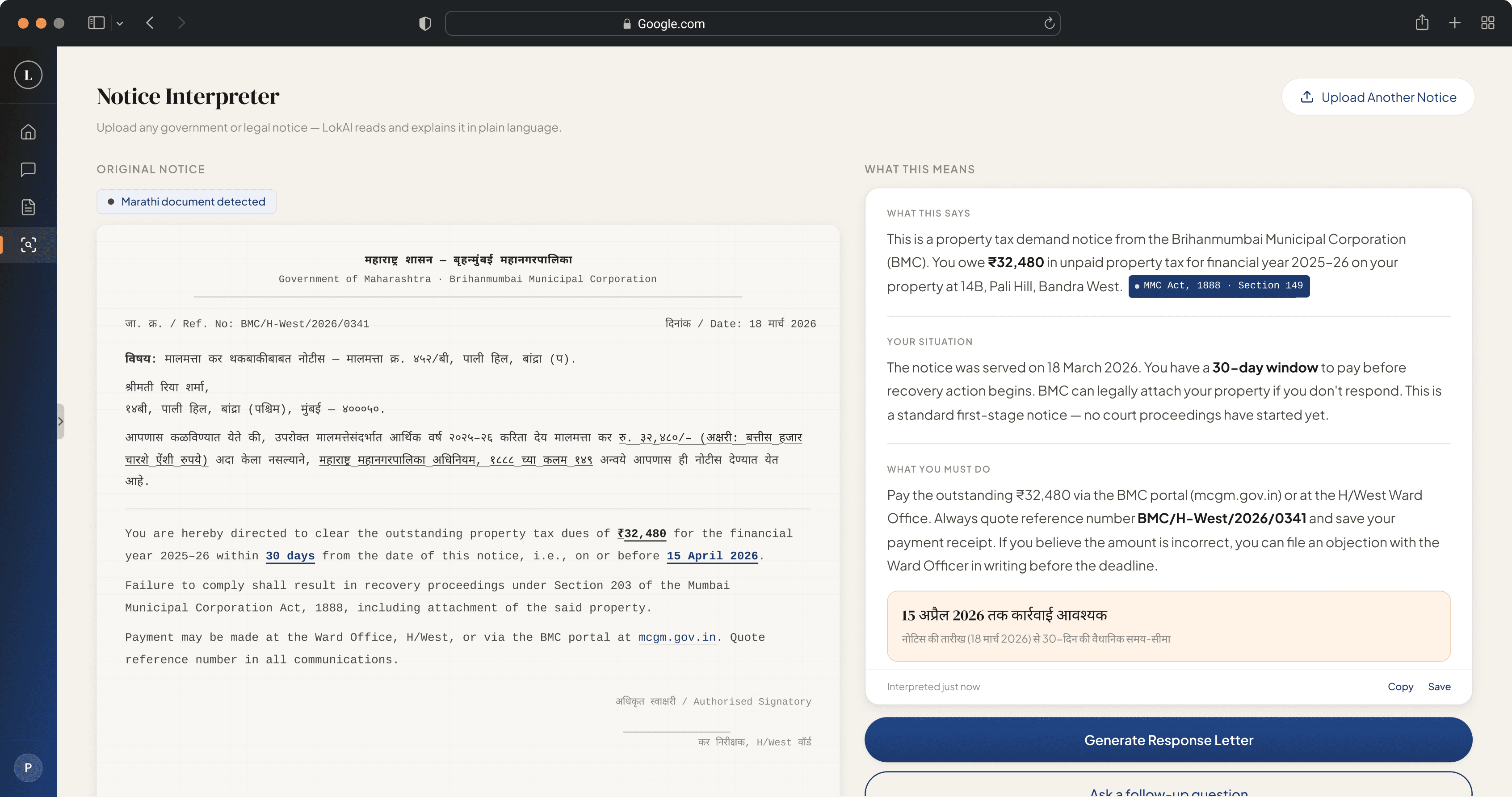
/ Notice Interpreter
Left column: the original Marathi document with "मराठी दस्तावेज़ पहचाना" badge and OCR
status. Right column: three-zone interpretation with the deadline callout dominating. The
deadline is saffron-bordered, largest text on the panel — because it carries the highest
consequence for inaction.
The response card — the product's most important artefact
Most AI products return responses as flowing text in a chat bubble. For legal information, this fails the
user. A wall of text is unscannable. A chat bubble scrolls away. The most important sentence gets buried.
LokAI's response is a structured response card — three distinct zones, visually separated, with clear hierarchy:
Zone 1
What the law says
The relevant legal position, with a
citation stamp confirming the
source
Zone 2
Your position
A plain language assessment
specific to the user's situation
Zone 3
What to do next
One primary action, not a menu of
options
Why this works:
→ Zone 1 builds trust (law)
→ Zone 2 builds relevance (user)
→ Zone 3 drives action
The main legal finding is set in large DM Serif Display italic — large, confident, readable in seconds.
Below it: the citation stamp. Together they communicate: this is a verified legal fact
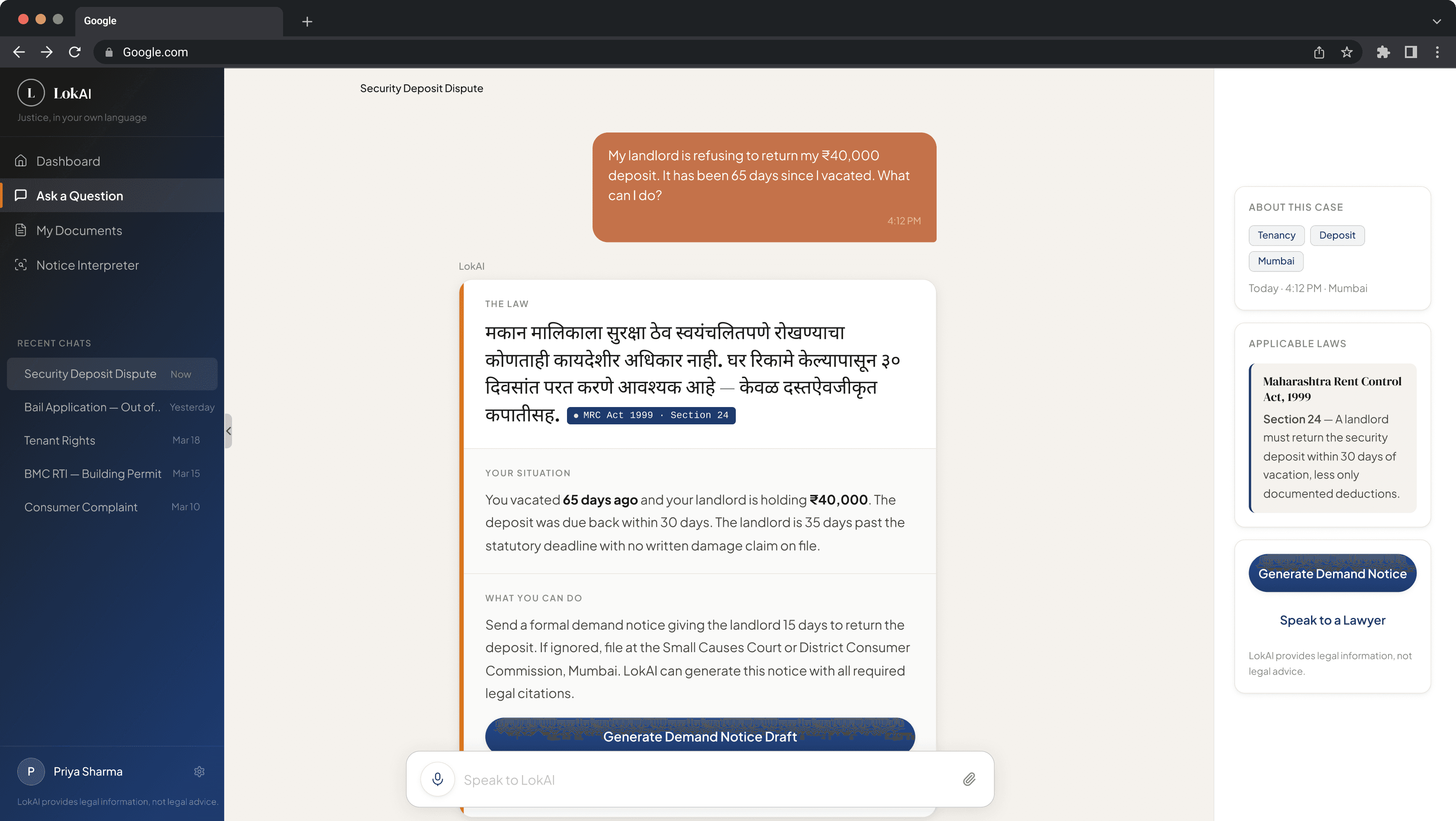
/ Response Card — Security Deposit, Marathi
The main legal finding is set large — DM Serif Display 20px italic. Below it: the citation stamp in navy monospace. The left border uses the response gradient. Three zones, one clear action button. No confidence percentage. No chatbot conversation. A response with a source.
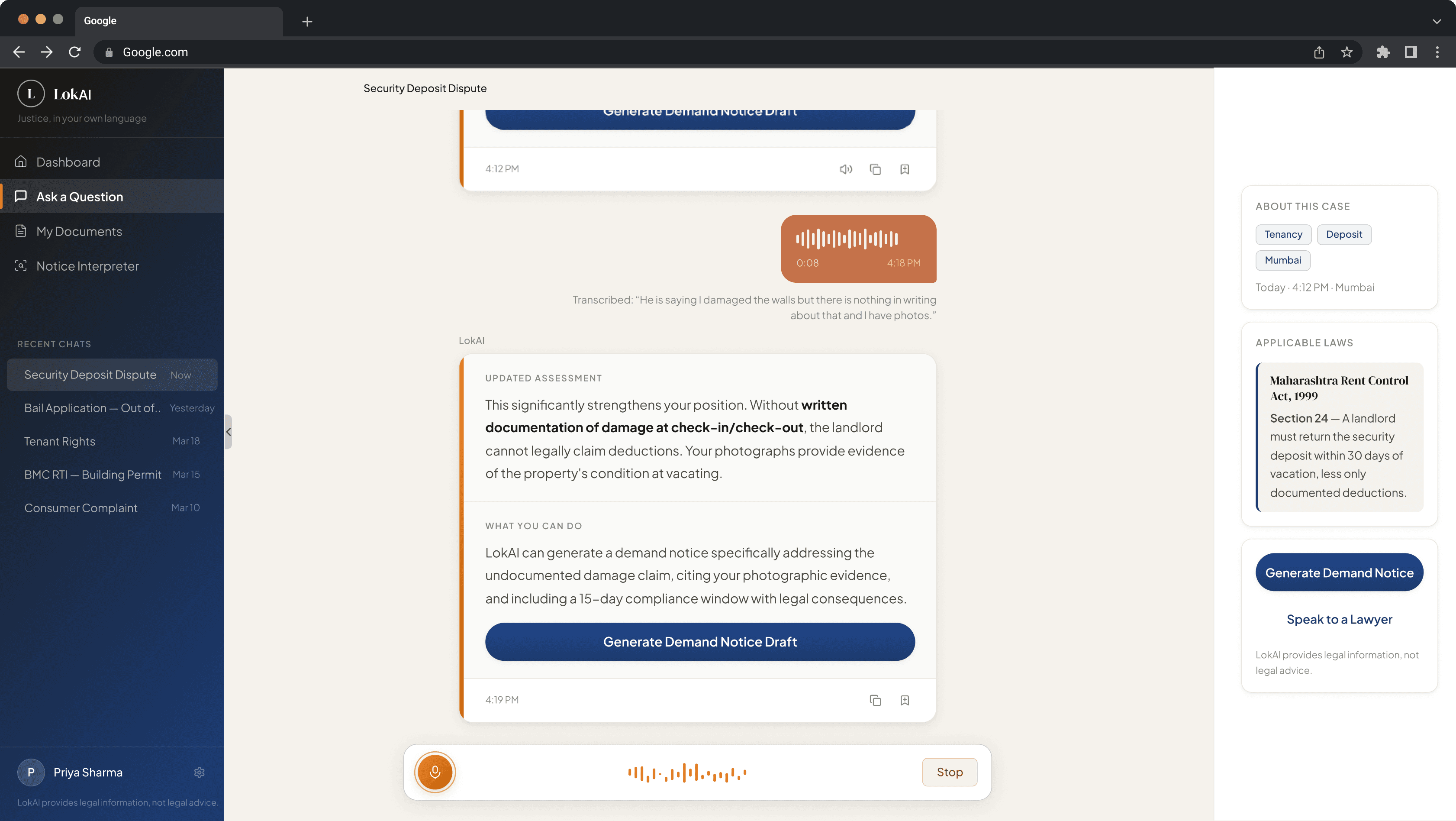
/ Voice Continuation — Updated Assessment
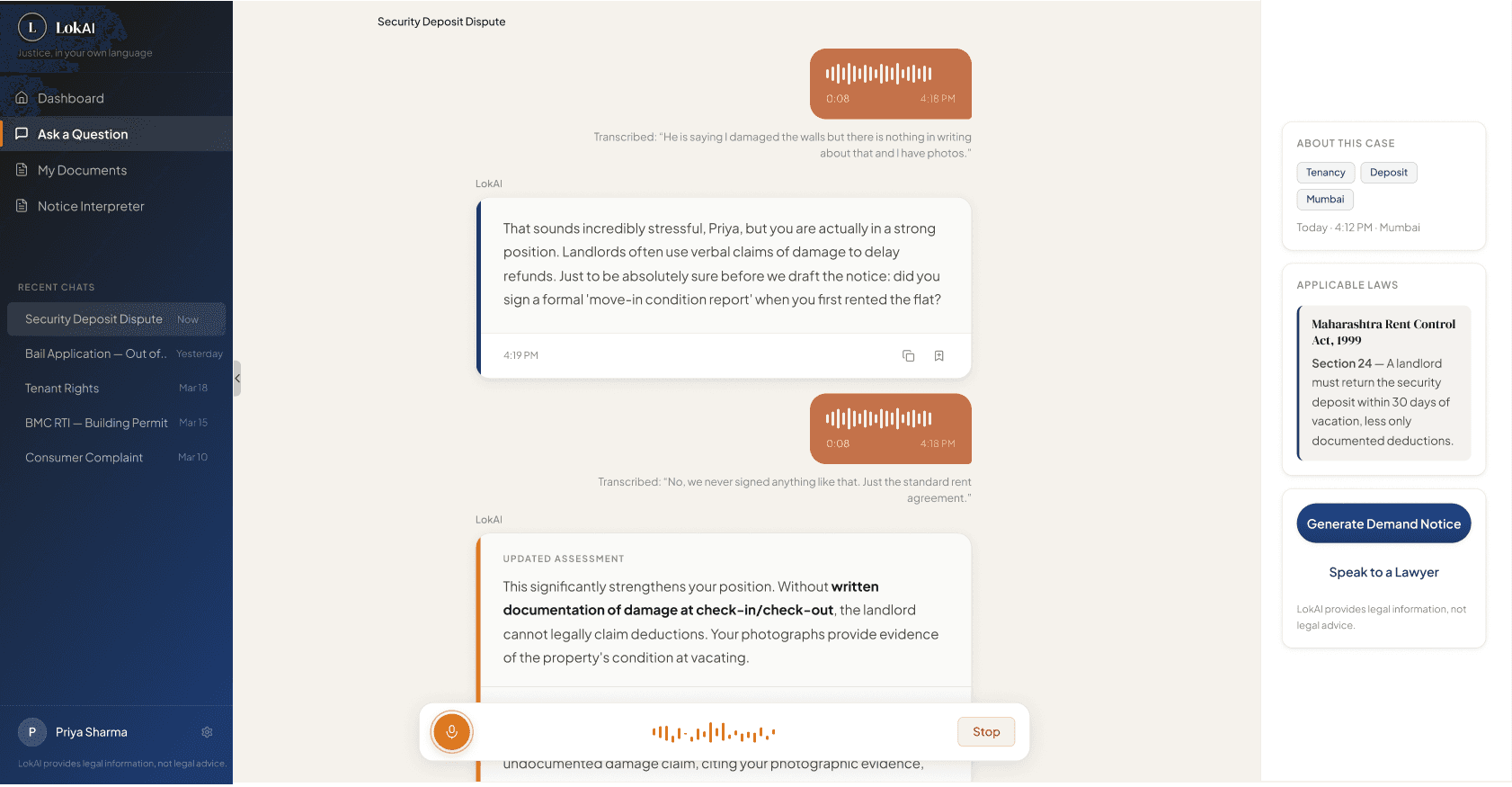
The user sends a voice follow-up: "He is saying I damaged the
walls but there is nothing in writing and I have photos." LokAI issues an Updated Assessment — a revision of its legal position.
The voice experience — trust in your own language
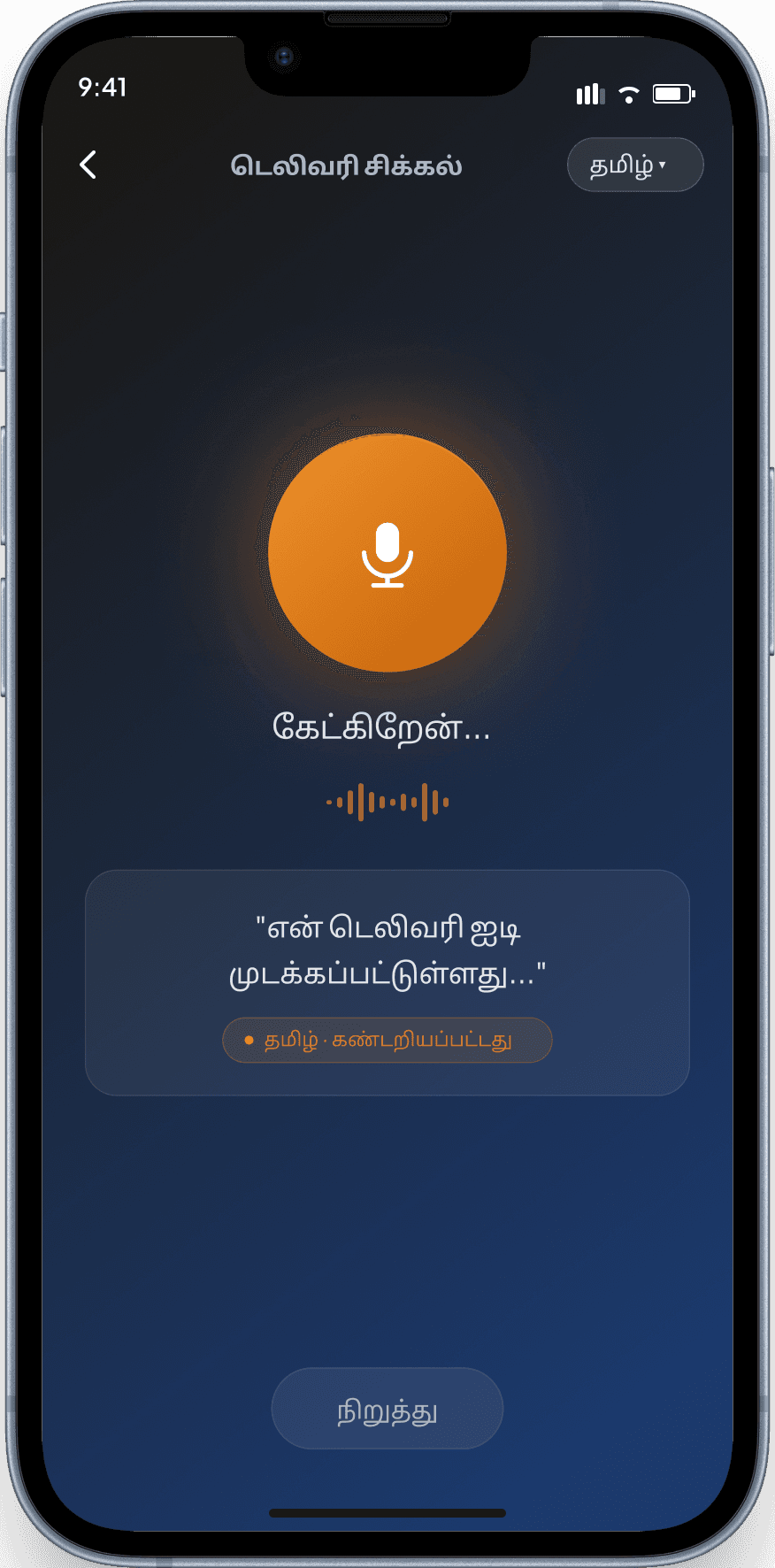
For many LokAI users, typing a complex legal situation is harder than speaking it. The voice input is
not just a convenience feature — it is supposed to be the primary interface for a significant portion of the user base.
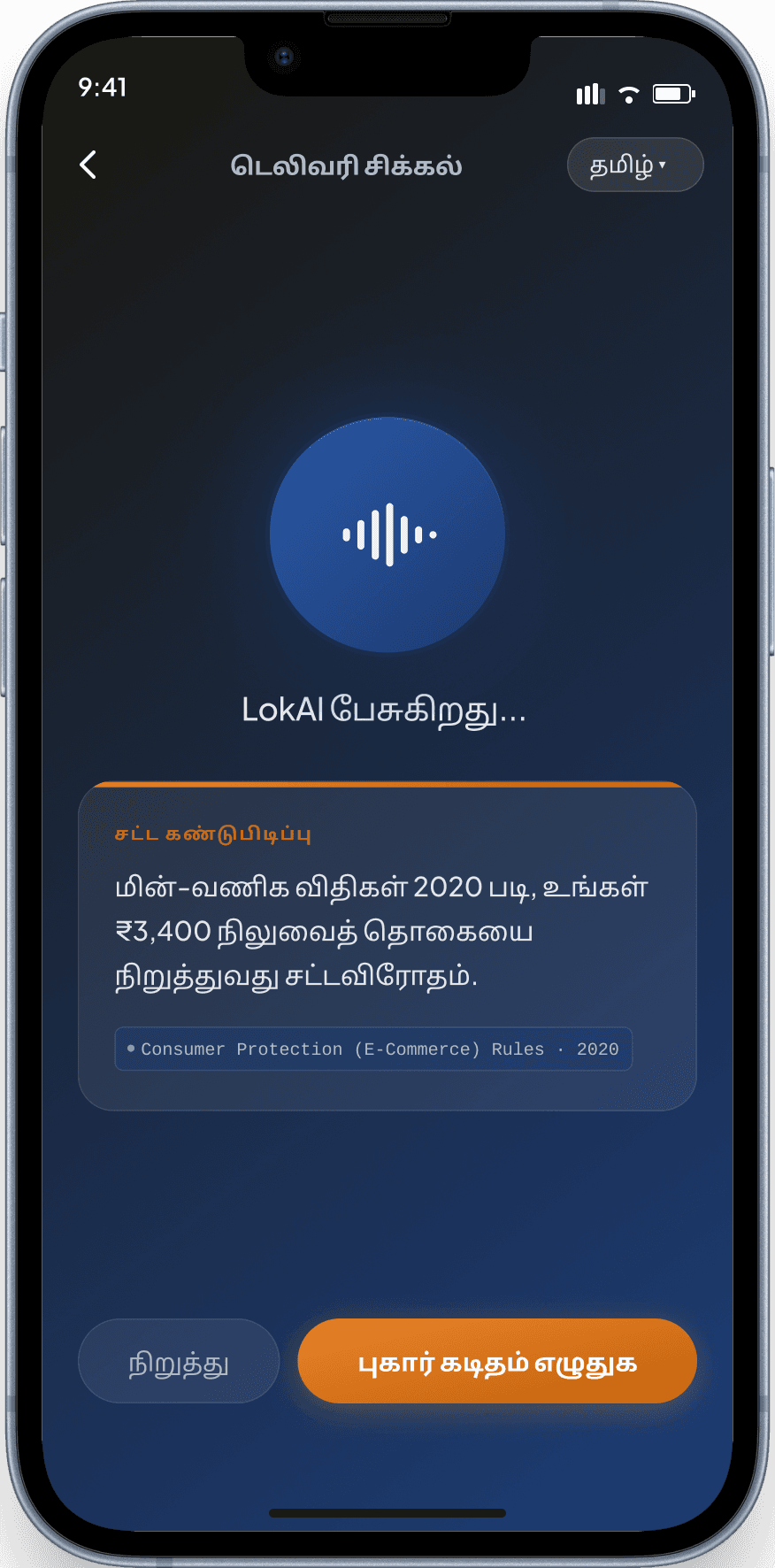
When a user speaks, the screen shows live transcription as the words appear — word by word, in their
language. The moment a user sees their words appearing correctly in their language, they trust that the system understood them.
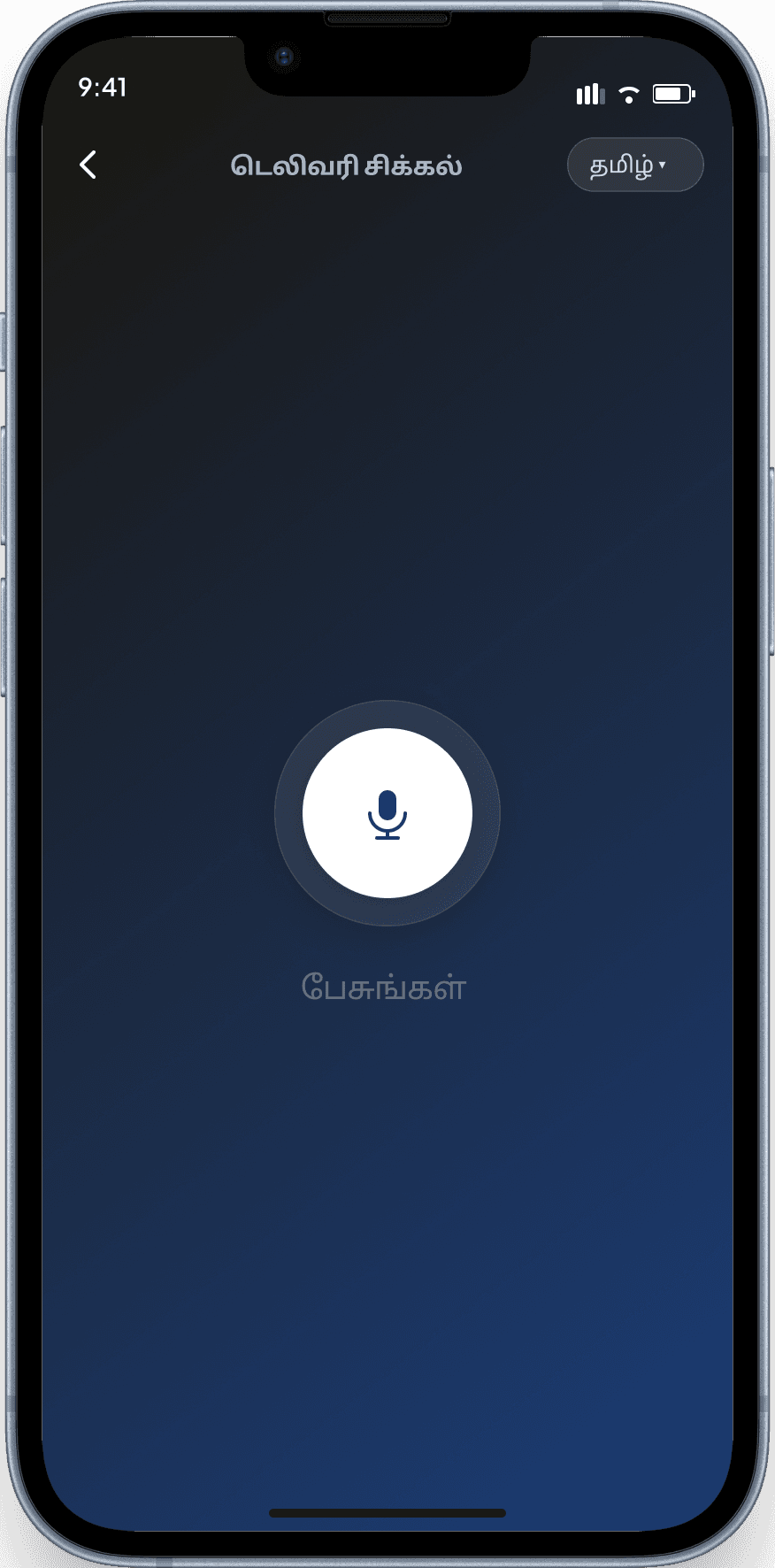
/ Voice Input States
The full screen becomes a listening state. Voice orb centered with pulsing rings. Live transcript text appears word by word below. Language chip auto-updates. The transcript is the experience — not a waveform, not a microphone icon, but the user's actual words being understood in their language in real time.
Document generation — automating the final step
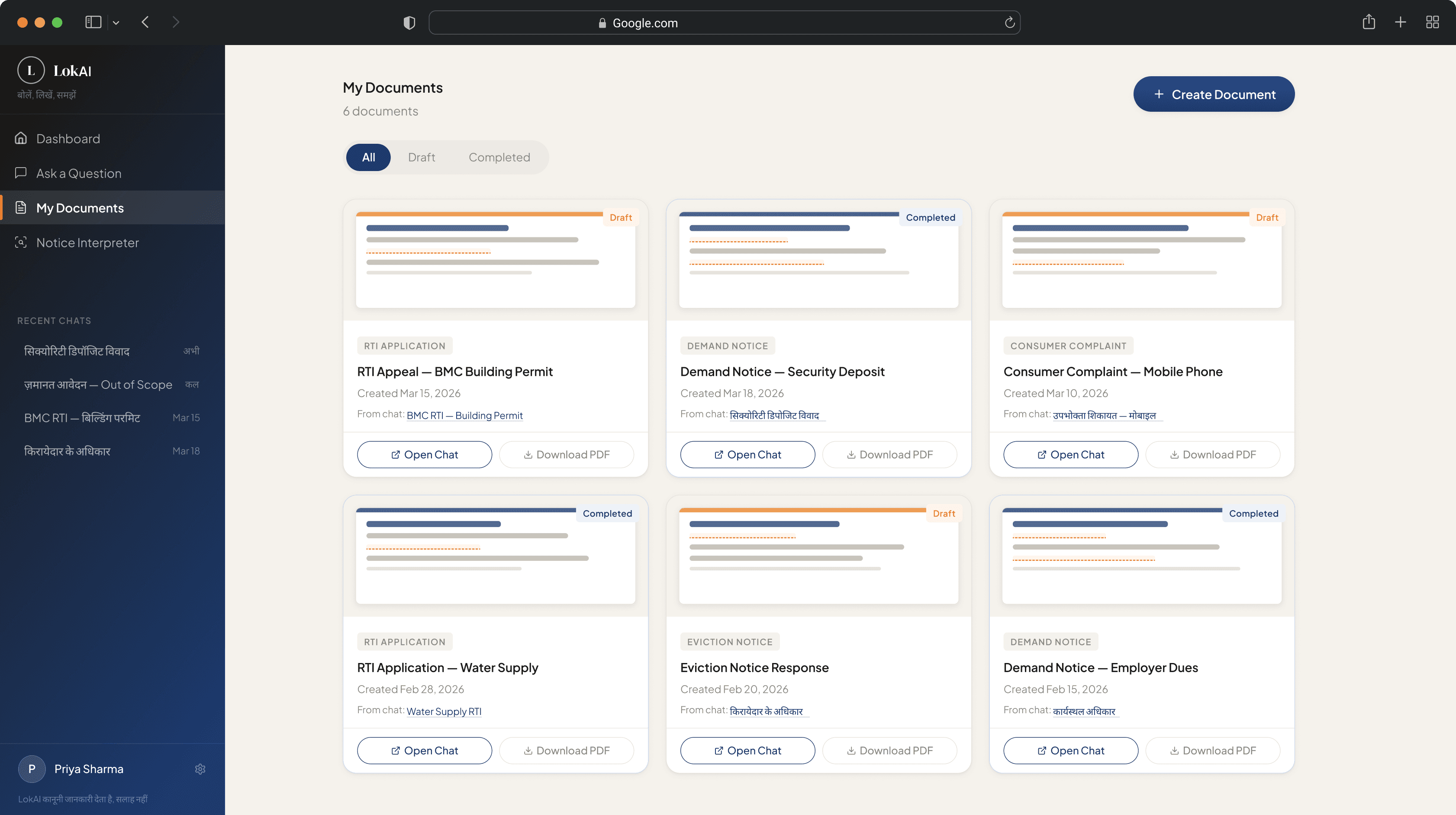
The highest drop-off in legal access happens when a user is told what to do but lacks the tools to actually do it. Facing a blank page to write a legal demand is intimidating. LokAI’s document engine bridges this gap by taking the citations and facts gathered during the chat and automatically transforming them into a formatted, ready-to-file artifact. It removes the anxiety of drafting.
/ MY DOCUMENTS
DASHBOARD
Legal disputes take months to resolve, requiring long-term utility. The dashboard acts as a personal legal repository, organizing active drafts and completed files. Crucially, every document card links directly back to the original conversational session (e.g., "From chat: BMC RTI — Building Permit"), ensuring the user never loses the context of why the document was created in the first place.
/ Document Generator
Every editable field uses a 2px dashed saffron underline — visually distinct from the
legal boilerplate. The safety stamp ("AI द्वारा तैयार Draft — दाखिल करने से पहले जांचें") sits directly
below the title, before the user reads any content. "What to do next" closes the loop:
where to submit, the 30-day statutory response window, what to do if there's no response.
09 — Design Decisions
Every decision was a response to a specific user problem.
Hybrid conversational interface over pure chat
Response design
Problem
Legal information in a scrolling chat is unscannable, but a purely structured, form-based interface feels robotic and lacks empathy for an anxious user navigating a dispute.
Decision
A deliberate modality shift. LokAI uses standard chat bubbles for intake, clarifying questions, and empathy. Once a legal conclusion is reached, the UI shifts to outputting a structured Assessment Card.
Rejected
Standard open-ended chat UI. Rigid intake forms that strip the user of the ability to tell their story.
Naming note
Early versions called the structured output a "VerdictCard." Renamed to Assessment Card— a verdict implies judicial finality that LokAI has no authority to deliver. The system assesses; it does not rule.
Tradeoff
Requires clear visual distinction so the user understands when the system is just "talking" versus when it is delivering a definitive, cited legal finding.
Citation stamp as the only trust signal — no confidence percentages
Trust system
Problem
I initially considered to build trust using "Confidence Scores" (e.g., "94% Match") for LokAI. However, in high-stakes legal scenarios, telling a user "I am 85% sure this law applies" creates anxiety, not trust. It forces a stressed citizen to calculate mathematical risk before taking action.
Decision
I abandoned arbitrary AI accuracy metrics entirely. The only trust signal is the Citation Stamp. It acts as binary proof: if LokAI retrieves and verifies a specific legal section, it stamps it. If it cannot verify the exact law, it defaults to general guidance without a stamp.
Rejected
Confidence percentage badges ("94% confident"). High/medium/low labels. Color-coded accuracy indicators.
Tradeoff
Harder to explain to stakeholders who want a visible accuracy metric. But the user acts on what the system does, not on a number they cannot interpret.
The citation stamp in context:
A landlord has no automatic right to withhold a security deposit. It must be returned within a
reasonable period — typically 30 days. At 65 days, the delay is well past any reasonable
standard.
RTI Act 1999 · Section 24
Pinned citations via a "Sticky" Sidebar
COGNITIVE LOAD
Problem
Legal disputes require context. If a user scrolls up through long chat history to remember the specific legal section cited earlier, they lose confidence and leverage.
Decision
High-consequence legal facts and citation stamps are "pinned" to a right-hand sidebar. As the conversational dialogue continues to scroll on the left, the core legal position remains static and constantly visible on the right.
Also fixed
Eliminates the memory tax. The user doesn't have to hold complex legal sections in their working memory while discussing their next steps. The leverage never scrolls out of sight.
Multilingual identity through content and color, not symbols
Identity
Problem
Early logo used "लो" (Devanagari, first syllable of "Lok") — which made LokAI look like a Hindi- only app. Indian identity was achieved through decoration, not design.
Decision
Logo uses a Latin "L" in a circle — universally readable, not language-specific. Indian identity is expressed through: language chips in native scripts (हिन्दी, தமிழ், বাংলা), Hindi chat conversations as demo content, Devanagari in the hero band. The product demonstrates multilingual capability; the logo does not have to carry it alone.
AI suggestions
Rejected
Ashoka Chakra loading animations. Jaali-work overlays. "Indian craftsmanship" gavel icons. All decoration over function.
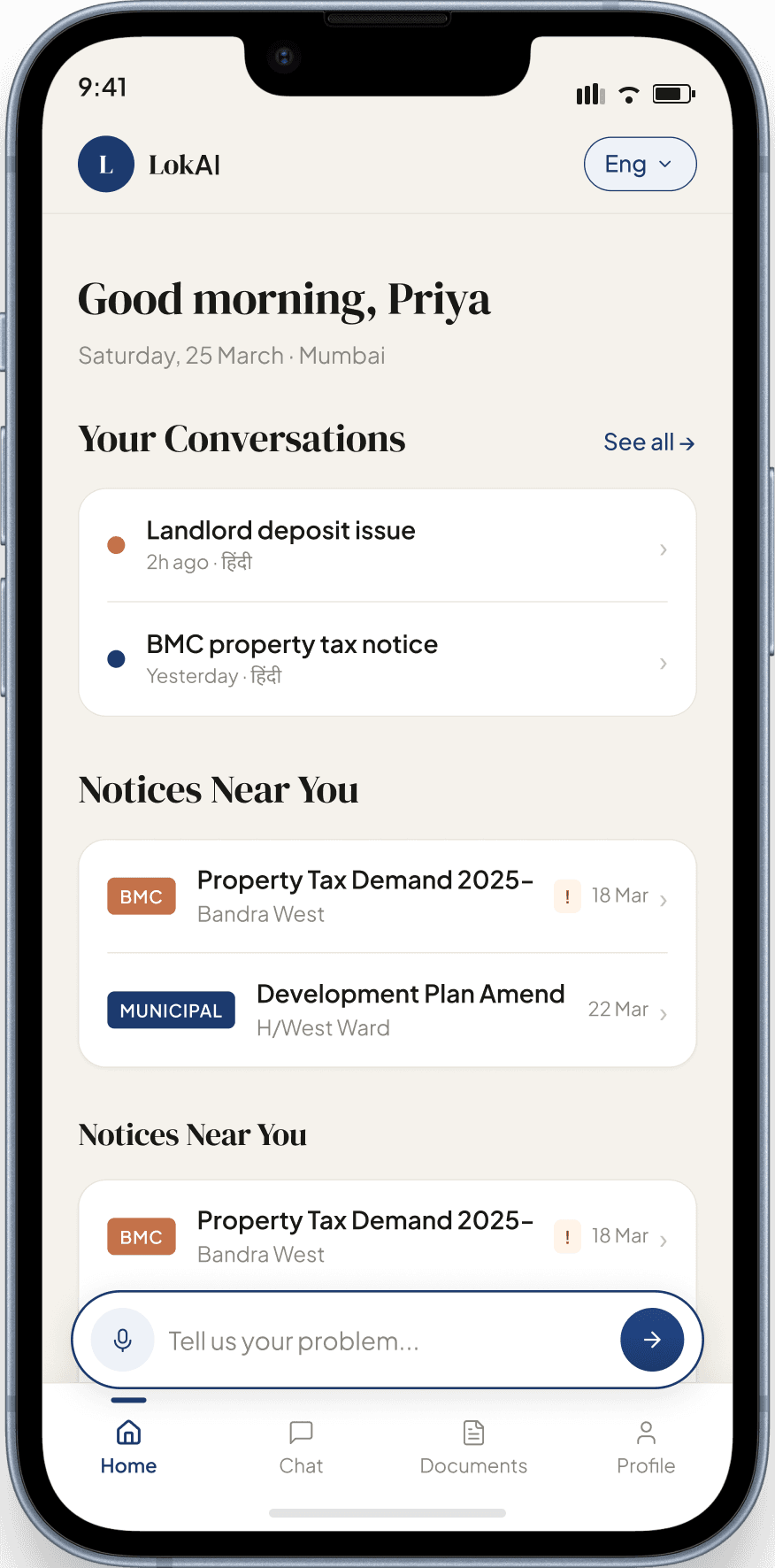
Home — input bar at bottom, Hindi hero
band, bilingual chips
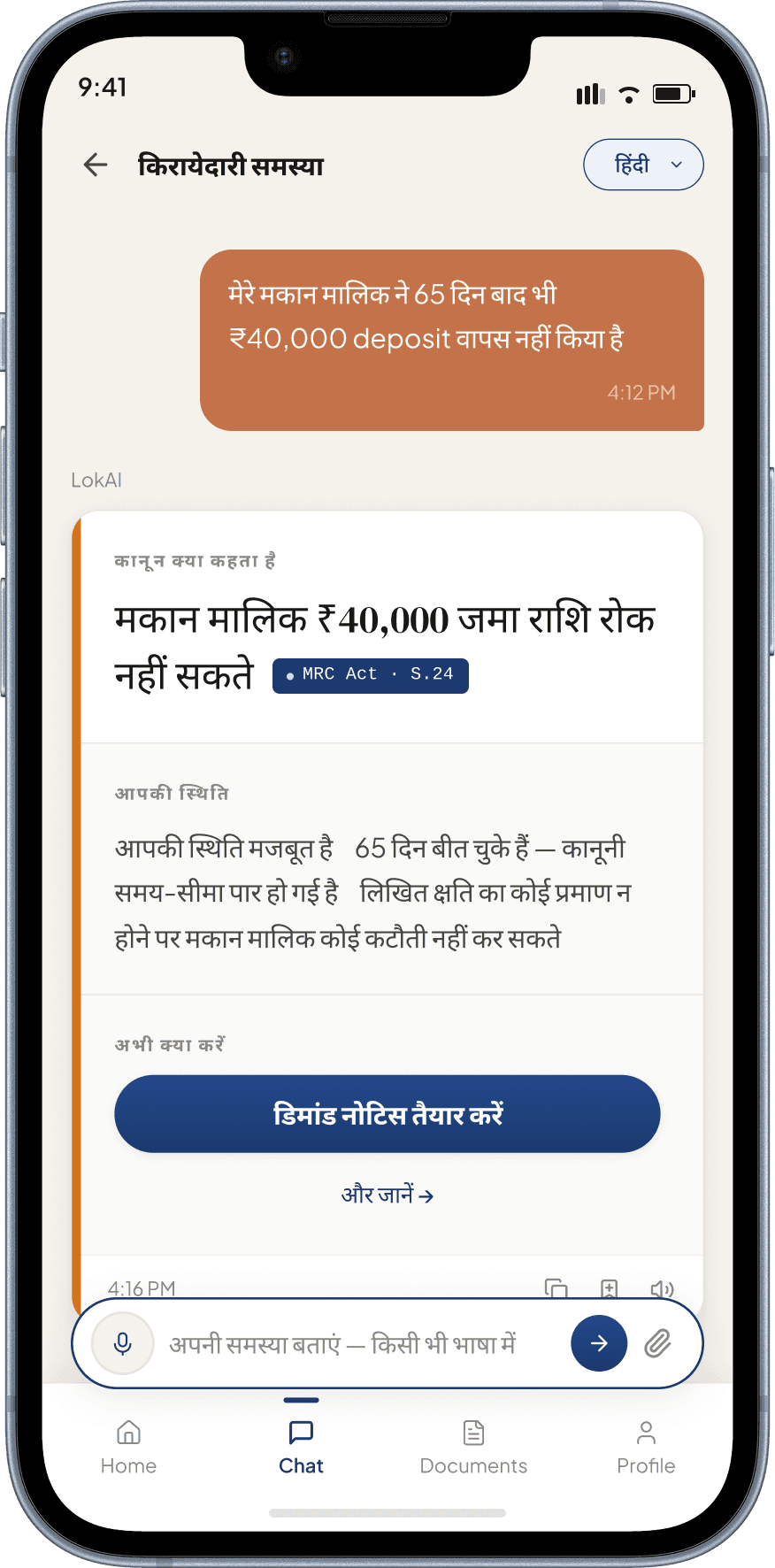
Full Hindi conversation — terracotta
bubble, Hindi response card, Hindi
citation stamp
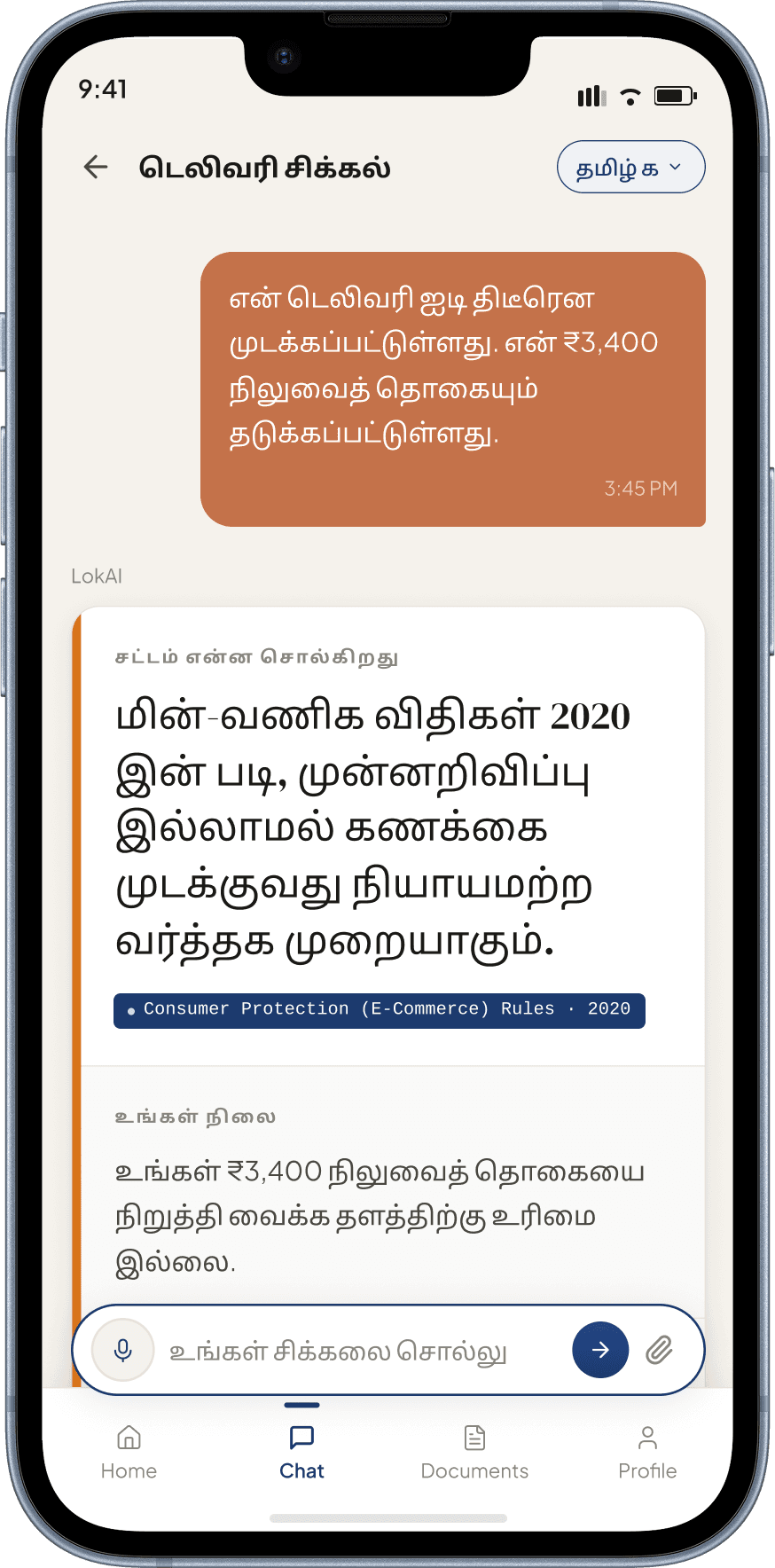
Full Tamil conversation — demonstrates
cross-script capability, citation stays in
English
10 — Edge Cases & Failure States
A legal product earns trust at the edges, not just the happy path.
Every failure state in LokAI is designed with the same principle: do not alarm the user unnecessarily.
This person is already anxious. The interface should remain calm even when something goes wrong.
OCR FAIL
Preventing dead ends.
Clear photography tips help the user retry. The crucial element is the secondary fallback ("Describe the notice instead"). It ensures a camera issue doesn't trap an anxious user in a technical loop.
Microphone access needed
Enable microphone in Settings, or type your question below.
Open Settings
Network / model error
Two recovery actions.
Try again + Copy my message. Thesecond matters — the user
typed out a stressful situation
and shouldn't lose it to a network
failure. Warning dot on the voice
orb signals degraded state.
Something went wrong
Network issue — please try again
Try Again
Copy my message
Microphone denied
Graceful degradation.
Denying permissions shouldn't block the user. A primary CTA offers a direct fix via Settings, while the UI instantly pivots to a text-first fallback.
Couldn't read the document
Try a clearer photo in good lighting — straight on, no shadows.
Try Again
Describe the notice instead
12 — What LokAI Is Not
The boundary is the product.
Knowing what to decline is as important as knowing what to do well. LokAI's scope is narrow by design
— not because of technical limitation, but because reliability within a defined domain builds more trust
than best-effort across an unbounded one.
LokAI will not
Replace a lawyer or provide legal advice
Handle criminal law, bail, or court proceedings
Generate contested property dispute documents
File documents on your behalf
Guarantee outcomes or legal accuracy
Handle family law, custody, or succession
LokAI will
Tell you your legal position clearly
Generate RTI applications and consumer complaints
Interpret government notices in any Indian language
Generate demand notices with cited legal basis
Route you to human help when it cannot assist
Respond in the language you use, natively
Persistent disclaimer — always visible: "LokAI provides legal information, not legal advice."
This appears in the sidebar footer and below every action button.
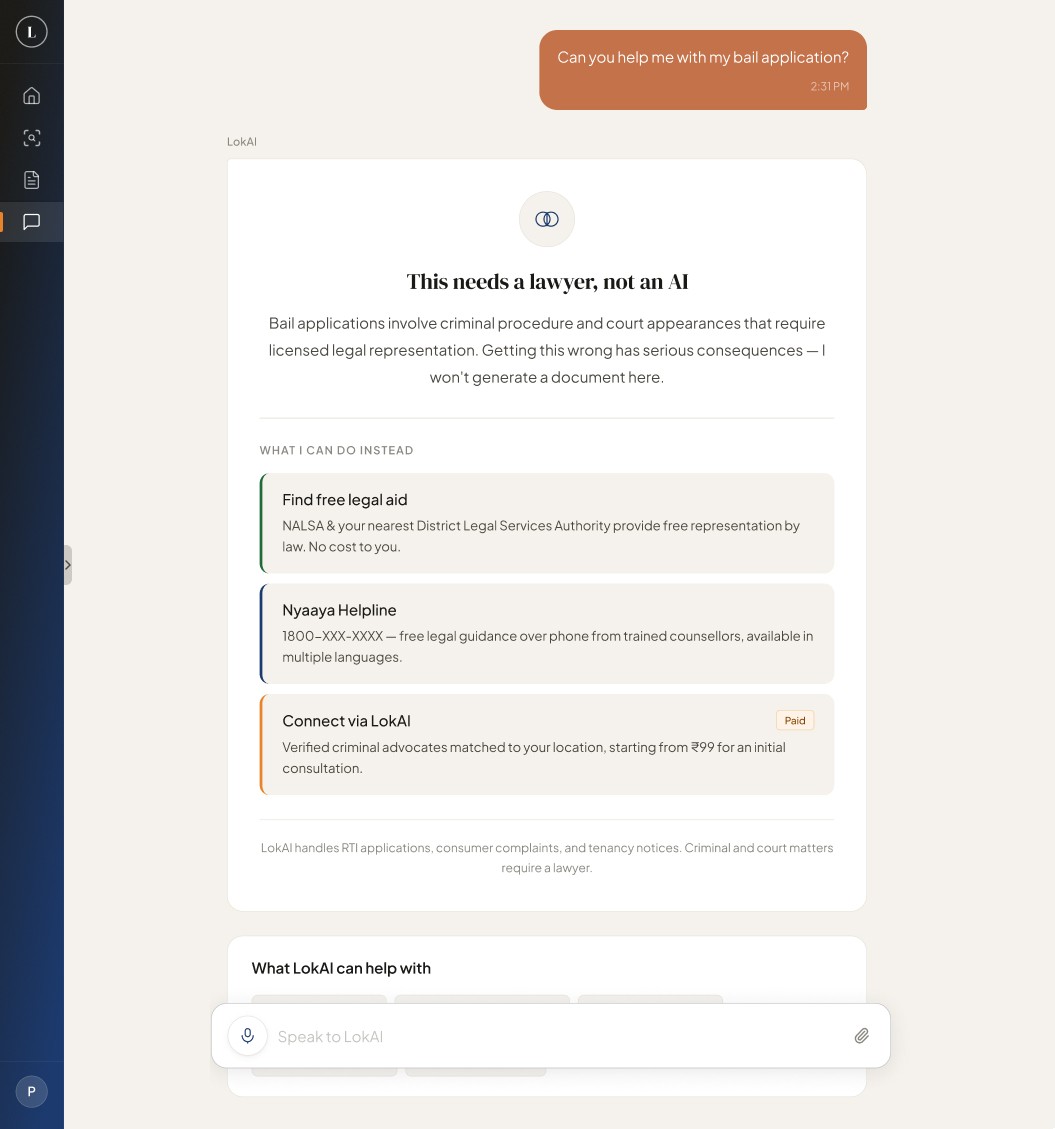
/ Boundary State
A bail application request — criminal law, outside LokAI's scope. White card, no red, calm
language. Three pathways stacked: NALSA (green — free), Nyaaya Helpline (navy — free),
Connect via LokAI (saffron — paid). The scope chips below show what LokAI can help with — so the user understands the product rather than feeling rejected.
13 — What I'd Measure
Three metrics. Each one answers a real question.
Action completion rate
Primary
Did the user download or share a generated document? Not "did they read the
response" — did they produce something they could file. The real question
underneath this: did someone file something they never would have filed
otherwise? Target: above 40% of sessions that reach the response card.
Boundary honesty rate
Safety
What percentage of out-of-scope queries route to human help rather than
generating a low-confidence document? A product that confidently drafts a
bail application is actively harmful. This metric tells you whether the scope
boundary is working — not just present in the UI.
Language input
distribution
Product health
Split of voice / Romanized text / native script across sessions. If voice is below
30%, there's a discovery or trust problem with the input design. If native script
is near zero, the no-keyboard-setup assumption held. This tells you whether
the multilingual system is actually being used — or whether users are
defaulting to English anyway.
14 — Reflection
What changed after research
The competitive scan forced a repositioning before any screen was designed. NyayGuru,
JuniorLawyer, and VakilAI had already built multilingual legal information tools. The differentiator
couldn't be features — it had to be the experience layer. That's what moved LokAI from "multilingual
legal chatbot" to "guided decision system designed for the emotional state of an anxious citizen." The
case study is stronger because of this pivot, not despite it.
What was initially wrong
The first problem statement was a comprehension problem. I spent two weeks on a legal Wikipedia
with multilingual support before noticing that the features I was most drawn to were action features —
document generators, not explainers. One user interview at the point of abandonment would have
surfaced this in an afternoon. I didn't do that interview. That gap is honest about its consequences:
every assumption about what users need at the action step is designed, not observed.
One specific naming decision I'd flag
Early versions used the term "VerdictCard" for the structured response output. Renamed to
ResponseCard when the implications became clear — a verdict is a judicial finding. LokAI has no legal
authority to deliver one. This sounds like a copy decision. It is actually a product definition decision: the
moment you name something a verdict, you've implied an authority the product doesn't hold.
Language shapes user expectation, and expectation shapes trust.
One UX decision I'd revisit
The Chat Summaries section on the dashboard shows conversation outcomes — what was discussed,
what was resolved, what to do next. In practice, a user returning to a legal dispute doesn't want a
digest. They want to continue exactly where they stopped, with the document they were building. The
summaries should be a continuation prompt, not a retrospective card. I designed for the wrong
returning-user mental model.
What remains unresolved
The hallucination risk is mitigated by the citation architecture, not solved by it. The curated knowledge
base and source-tagged retrieval reduce the probability of unverifiable legal claims. A production
LokAI needs periodic legal audits — human lawyers reviewing outputs against actual legal outcomes.
The design acknowledges this layer. It does not pretend to solve it.
LokAI doesn't win when it answers correctly. It wins when someone files
something they never thought they could.
Thankyou for reading :)
Checkout my other case studies
FlytBase Sentinel →
Feul.AI →
About Me→
LokAI is a product design case study. Not a licensed legal practice. All legal information shown
is for demonstration purposes only. LokAI provides legal information, not legal advice.