Product Design · AI · Civic Tech · India
LokAI —
Designing AI that knows its
place in Indian law.
A multilingual guided decision system that takes an Indian citizen from a
legal situation they don't understand to a document they can actually file.
Quick overview — 15 seconds
What it is
A mobile app that turns a legal situation into a filed
document, in the user's own language
The problem
Urban Indians know their rights are being violated
but can't navigate a legal system that runs entirely in
English
Core idea
Every response ends in an action, not just
information.
Understanding was never the barrier.
Taking the first step was.
Key decisions
→
The AI output is structured as guidance, not a
verdict — so it never implies legal authority the
product doesn't hold
→
Every legal claim shows its source citation, not a
confidence score — users can verify before they
act
→
Narrow, defined scope by design — reliability
within a boundary builds more trust than breadth
without it
Role
End-to-end product design
Type
Speculative · Portfolio
Platform
Mobile, web
Year
2025
What LokAI Does
Not a chatbot. A structured flow from situation to filed document.
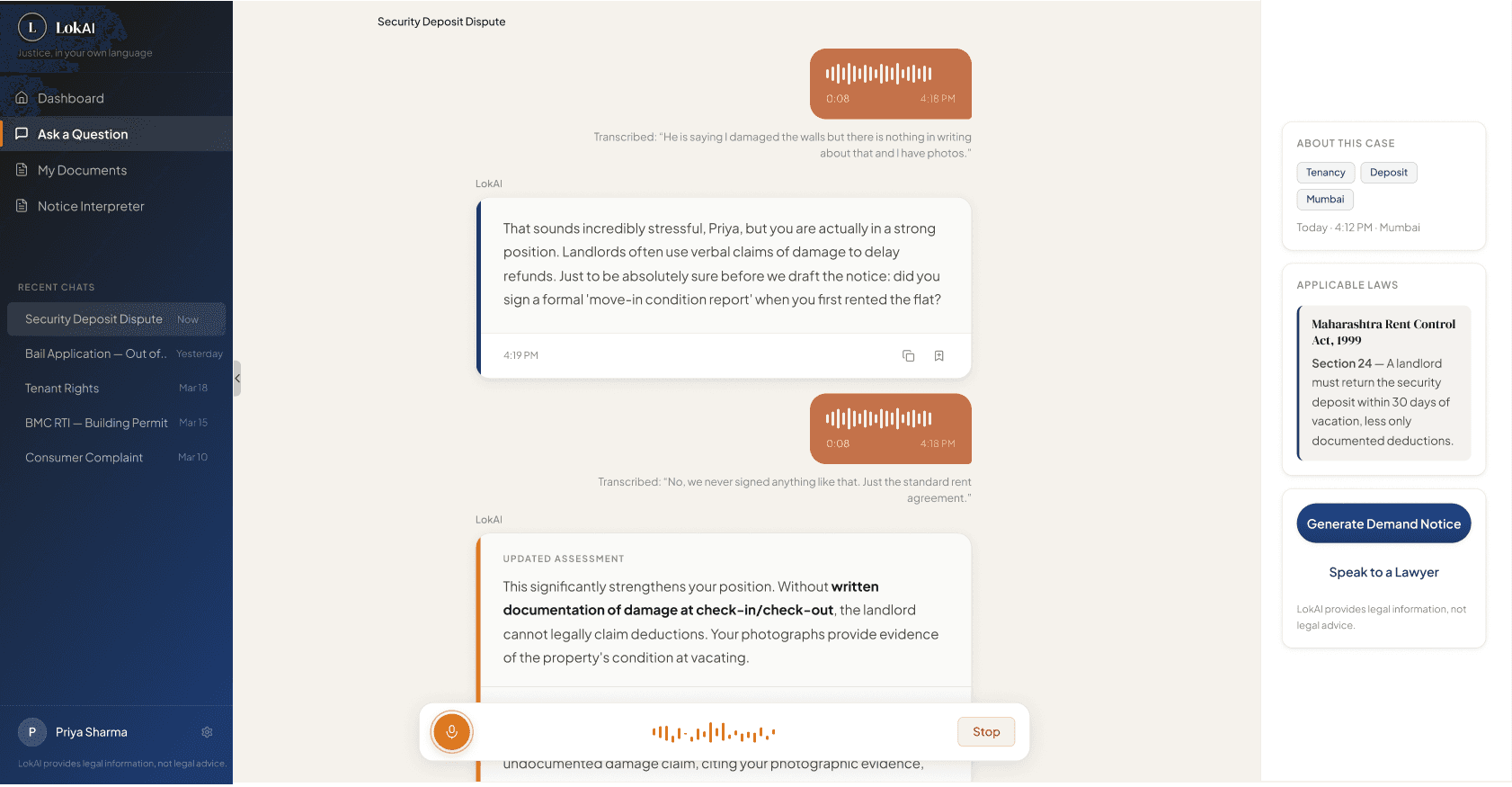
LokAI is for urban Indians facing everyday legal disputes — landlord notices, consumer complaints,
employer violations, platform account terminations. A user describes their situation by voice, text, or
photo upload. LokAI assesses it, returns a structured three-zone response card in their own language,
and generates a ready-to-file document with cited legal basis. The entire flow is designed to complete
in a single session.
5M+
Pending consumer court cases —
not for lack of legal standing, but
because most disputes never
become formal filings
80%
Of India does not primarily use
English. India's legal system operates
almost entirely in English
0
Existing tools designed for the
emotional state of an anxious citizen
rather than a curious researcher
Multilingual input, processed natively
Voice, Romanized text, or native script. The language
model processes in Tamil, Bengali, Marathi, Hindi —
not via English translation in the middle.
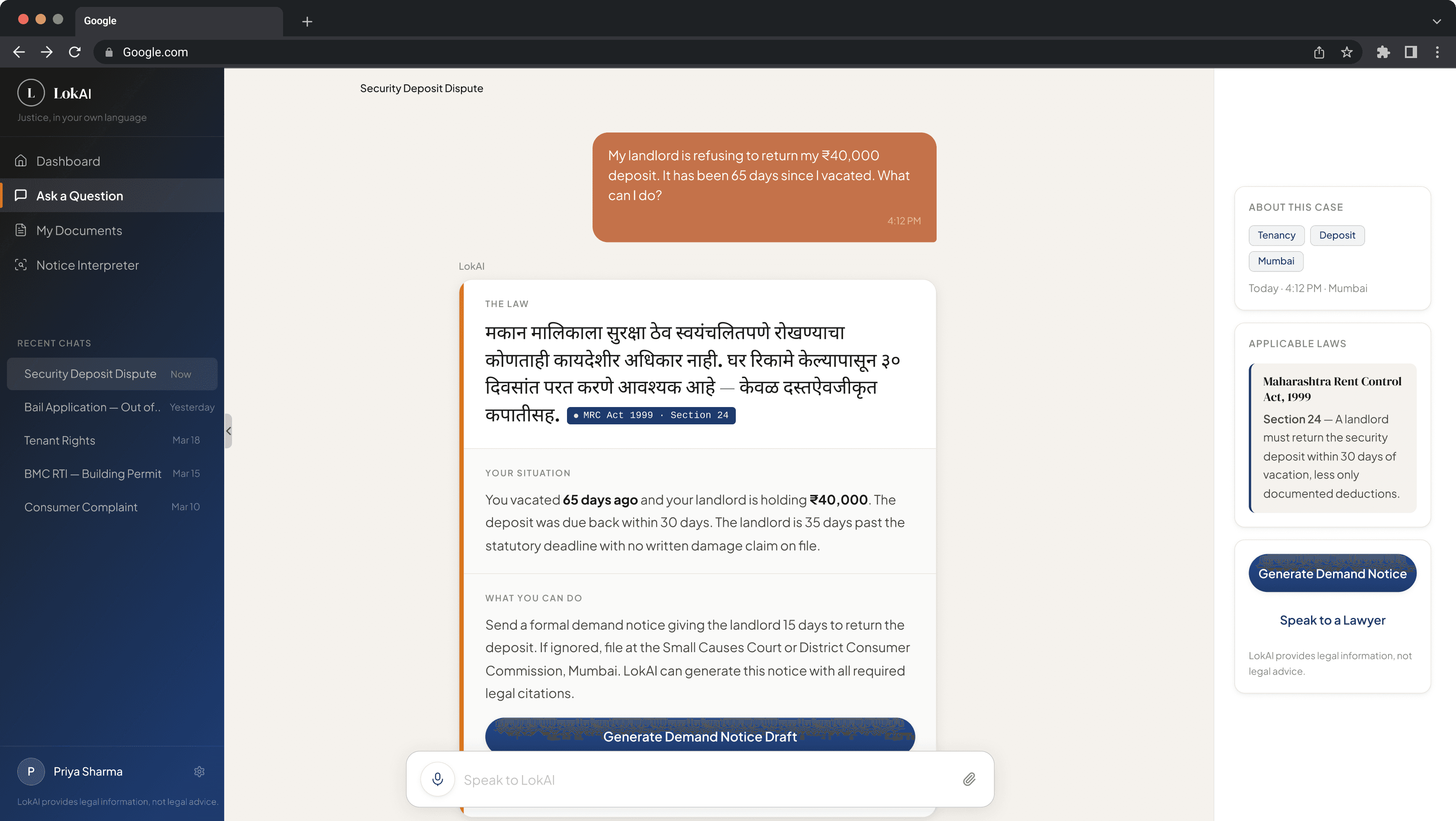
The ResponseCard — core product artifact
Three-zone structured output: THE LAW tells them
what applies. YOUR POSITION tells them where they
stand. WHAT YOU CAN DO gives them one specific
next step.
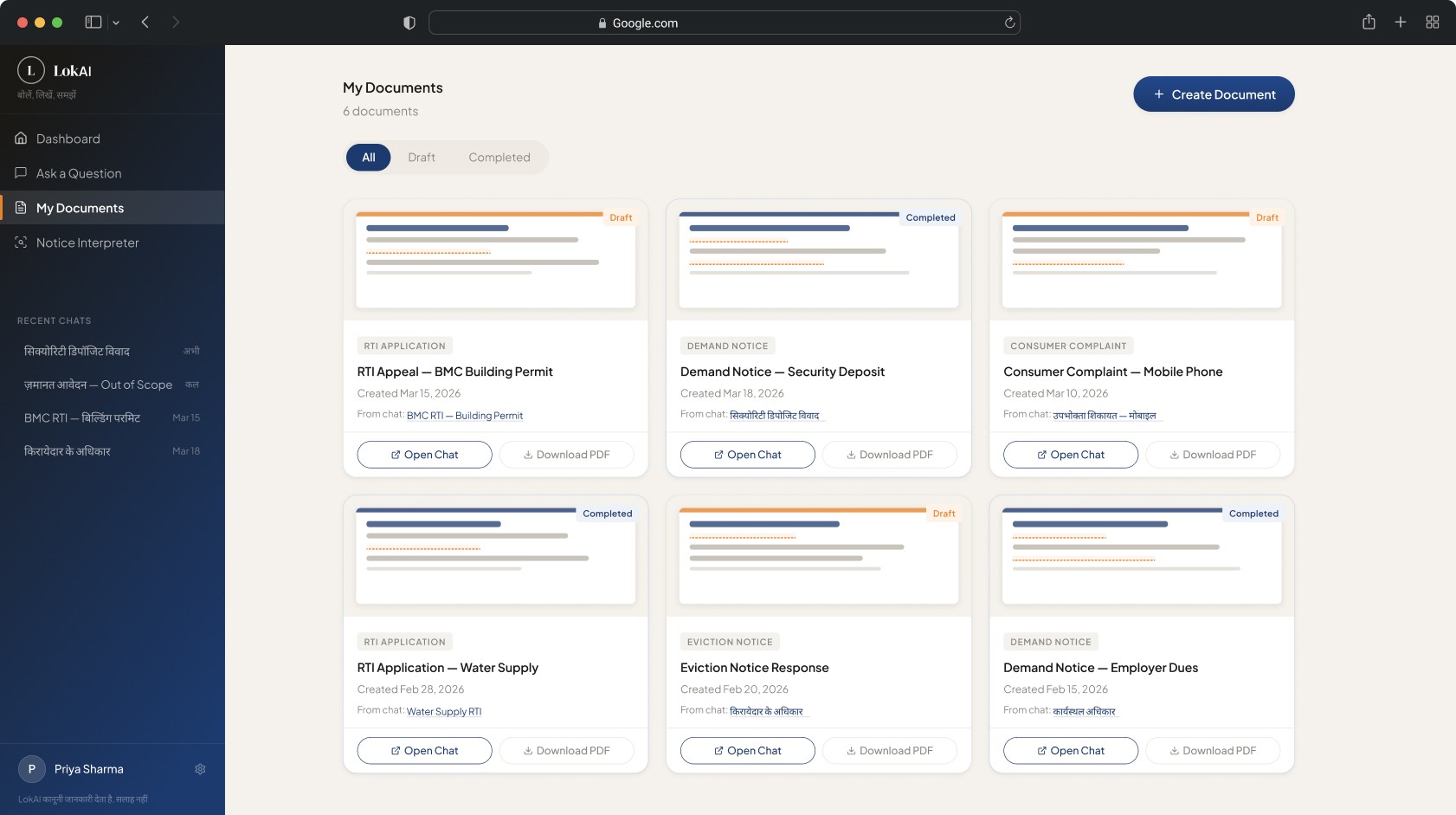
Ready-to-file documents, cited
RTI applications, consumer complaints, demand
notices — editable fields with dashed saffron
underlines, a safety stamp before the user reads any
content, and statutory next steps that close the loop.
Scope is defined, not unlimited
Criminal law, bail, court proceedings — explicitly
declined with specific human pathways offered. The
scope boundary is not a technical limitation. It is the
product's integrity.
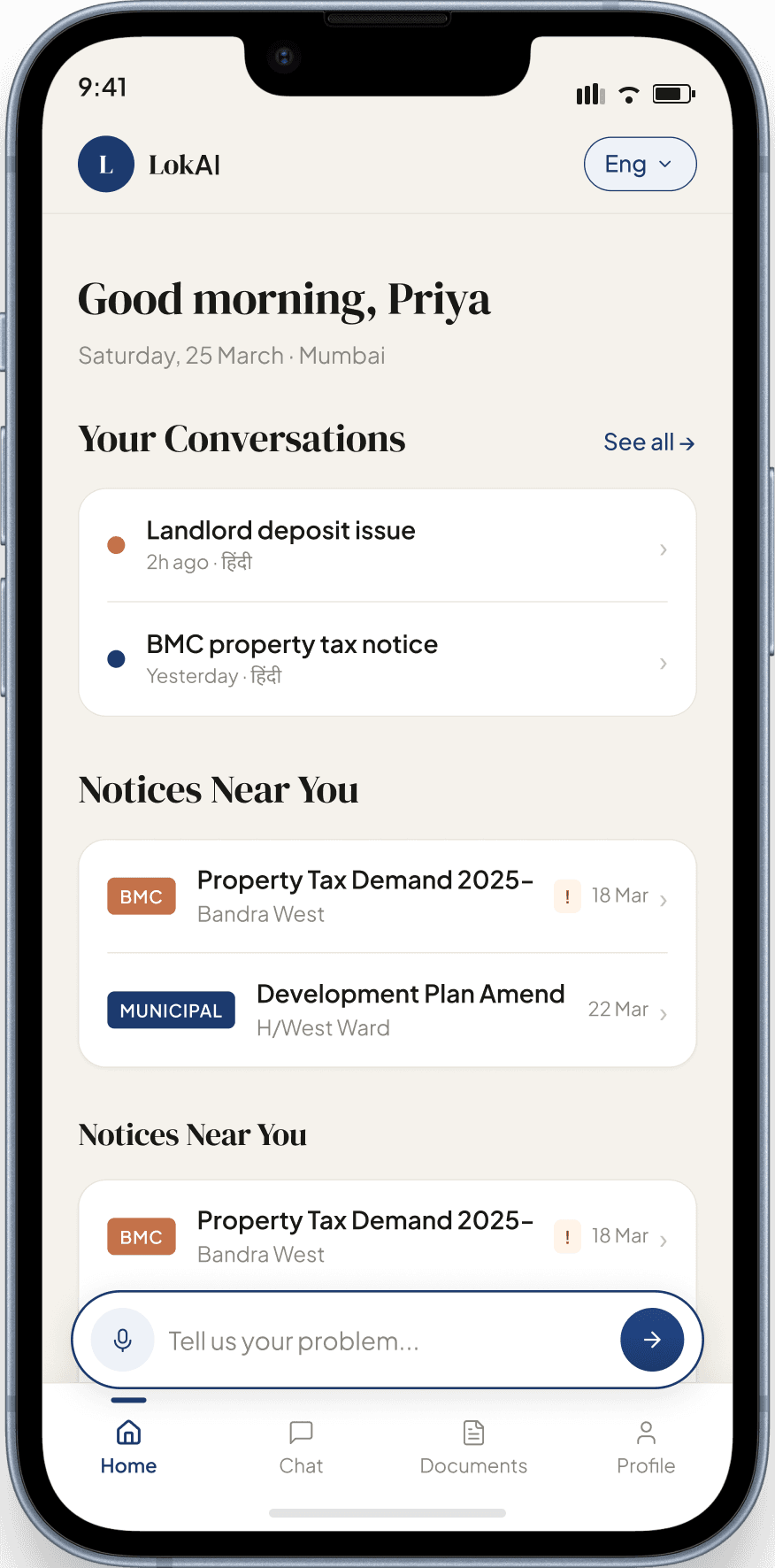
Home — input bar at bottom, Hindi hero
band, bilingual chips
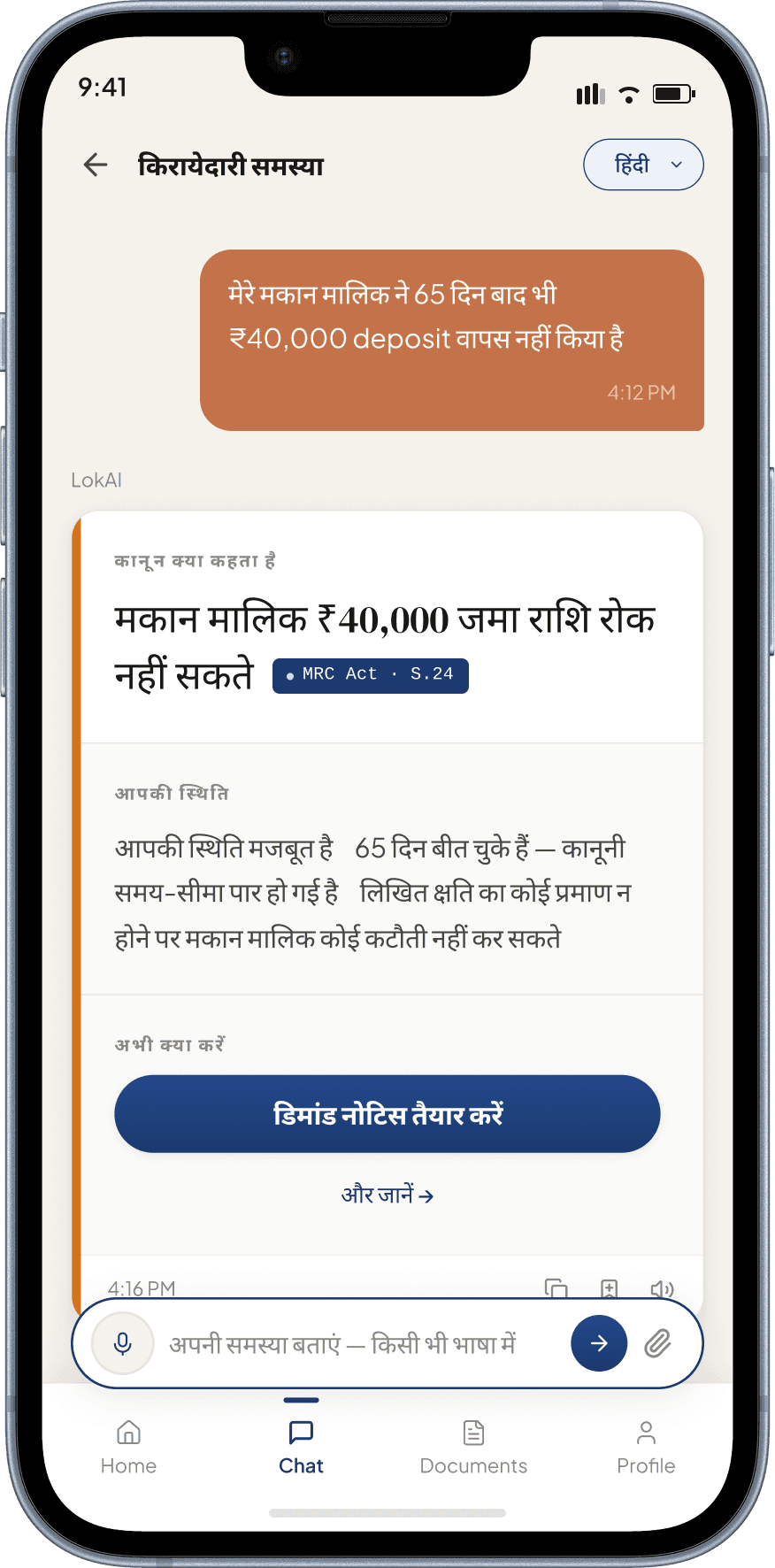
Full Hindi conversation — terracotta
bubble, Hindi response card, Hindi
citation stamp
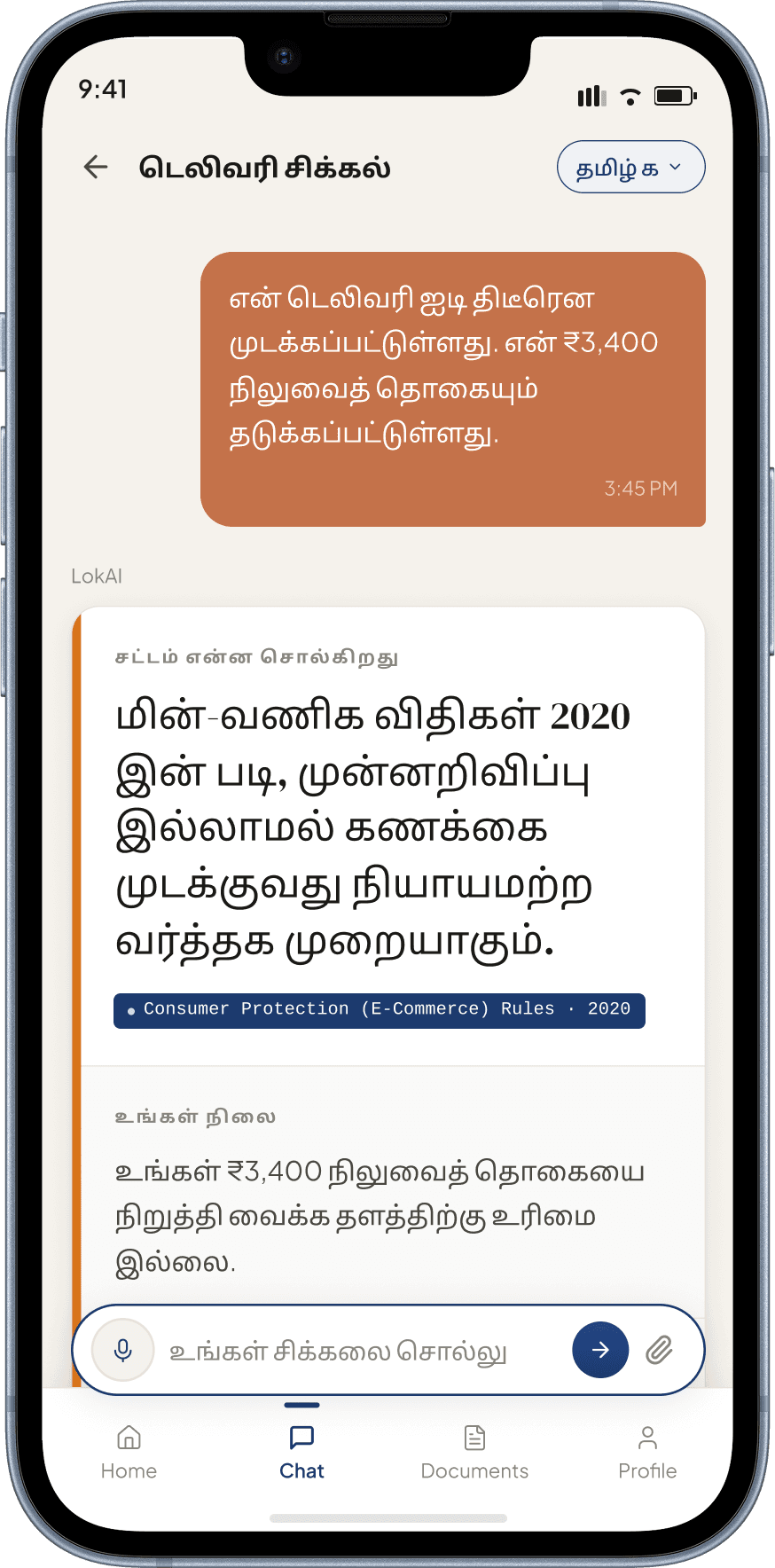
Full Tamil conversation — demonstrates
cross-script capability, citation stays in
English
The ResponseCard — anatomy of the product's central output:
LokAI ResponseCard
Landlord notice claiming unpaid rent — Maharashtra Rent Control Act
The Law
Under the MRC Act, a landlord
cannot issue eviction notice
without first providing a written
rent demand and a 30-day cure
period.
Your Position
You have legal standing. If no
written demand preceded this
notice, the notice is procedurally
invalid.
What You Can Do
Send a demand notice disputing
the eviction. Generate the
document below — it cites the
specific section that applies.
MRC Act § 12(3)
CPC Order 37
Sources cited · Tap to verify
What LokAI handles — and what it deliberately does not:
LokAI will
Tell you your legal position clearly
Generate RTI applications and consumer complaints
Interpret government notices in any Indian language
Route you to human help when it cannot assist
LokAI will not
Replace a lawyer or provide legal advice
Handle criminal law, bail, or court proceedings
File documents on your behalf
Guarantee outcomes or legal accuracy
Research Direction
Three competitors already existed. The differentiator had to be experience, not
features.
The competitive scan changed the direction before any screen was designed. NyayGuru, JuniorLawyer,
and VakilAI had already built multilingual legal information tools with reasonable coverage. Competing
on features was not viable. The gap in all three was the same: they were built by developers to
demonstrate capability, not designed from the user's emotional state outward.
The pivot this produced
Before
Build a better legal Wikipedia — multilingual, comprehensive, well-structured.
Finding
I started with a comprehension problem. Two weeks in, I noticed every feature I was drawn
to was an action feature — document generators, not explainers. The problem was never
reading. It was filing.
After
Every response must end in something the user can do. The product's measure of
success is not whether they understood — it is whether they filed.
One user interview at the point of abandonment would have surfaced this in an afternoon. All research here
was desk research. That gap is honest about its consequences — every assumption about the action step is
designed, not observed.
Key Design Decisions
Three decisions that shaped the product itself, not just the interface.
01
The output card communicates guidance, not legal authority
Product definition
✗ Earlier version
The output was called a "VerdictCard" — the same
word used for what a judge delivers. Three zones:
Analysis, Verdict, Next Steps.
✓ Final version
Renamed to "ResponseCard." Zones restructured to:
THE LAW / YOUR POSITION / WHAT YOU CAN DO.
Structure implies guidance, not judgment.
Why this mattered
A verdict is a judicial finding. LokAI has no legal authority to deliver one. The moment you name something a
verdict, you've implied authority the product cannot responsibly claim. This reads like a naming decision. It is a
product definition decision — it determines what users expect from the output and whether they trust it within
appropriate limits.
02
The AI cites its legal source, not its confidence level
Trust design
✗ Earlier version
A confidence badge showed "87% confident" below
the response. The user had no way to verify or
challenge this number.
✓ Final version
A citation stamp shows the specific law — "IPC
Section 405 · Consumer Protection Act, 2019."
Tappable. User-verifiable against the actual source.
Why this mattered
A confidence score asks for blind trust. A source citation gives the user something to hold — and something to
challenge if they disagree. For someone filing a legal document based on AI output, knowing the cited law is
named and traceable is what makes it usable. Trust should be verifiable, not self-reported.
A landlord has no automatic right to withhold a security deposit. It must be returned within a
reasonable period — typically 30 days. At 65 days, the delay is well past any reasonable
standard.
RTI Act 1999 · Section 24
03
Defined scope over open-ended capability
Product scope
✗ Rejected
An open chat interface covering all legal queries —
maximally capable, but unreliable because general-
purpose AI hallucinates across legal jurisdictions.
✓ Chosen
RTI, consumer complaints, demand notices, and
notice interpretation only. Everything else explicitly
declined, with specific human pathways offered.
Why this mattered
Reliability within a defined domain builds more trust than best-effort across an unbounded one. A general-
purpose model might cite UK consumer law in response to an Indian complaint and the user would not know. The
narrow scope — and the calm, honest refusal for anything outside it — is not a limitation. It is the product's
integrity.
Honest Reflection
What I'd change, what I got right, and what the product still doesn't solve.
A UX decision I'd revisit
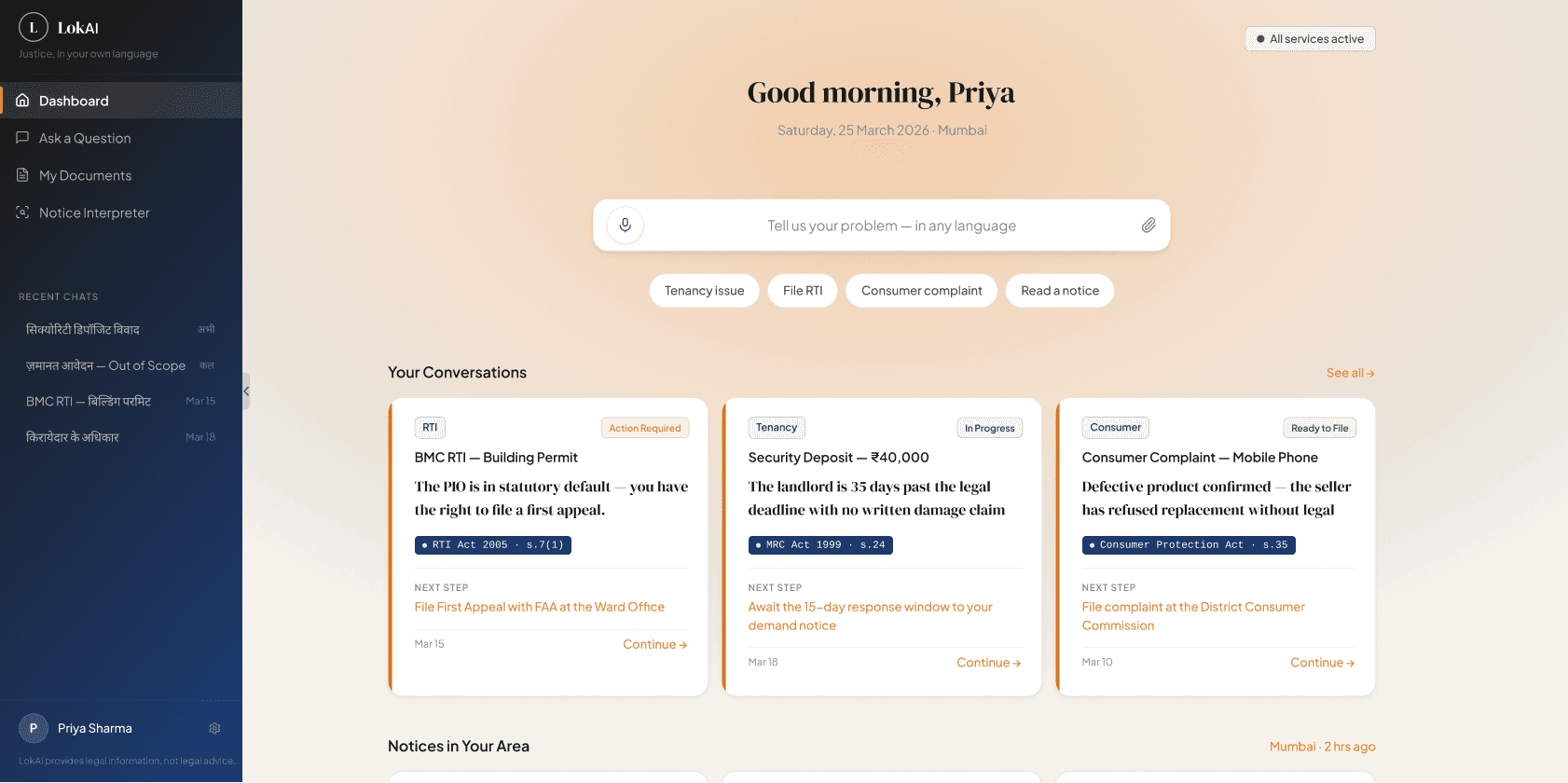
The dashboard shows Chat Summaries —
retrospective cards of what was discussed and
resolved. A user returning to an ongoing legal dispute
doesn't want a digest. They want to continue exactly
where they stopped. The summaries should be
continuation prompts, not retrospectives. I designed
for the wrong returning-user mental model.
What the product still doesn't solve
The hallucination risk is mitigated by the citation
architecture — source-tagged retrieval reduces
unverifiable claims. But it is not eliminated. A
production LokAI would need periodic legal audits by
human lawyers reviewing outputs against actual case
outcomes. The design acknowledges this layer. It
does not pretend to solve it.
LokAI doesn't win when it answers correctly. It wins when someone files something
they never thought they could.
The full case study goes deeper on everything here
Voice experience design, all six screen walkthroughs with per-decision
rationale, the complete edge state system, failure states for all six scenarios,
visual design system, three success metrics with reasoning, and the full
competitive analysis that forced the direction change.
Full case study