Mobile Design · Gig Economy · Audio Data · India
Feul.AI —
Rebuilding an earning
experience around pay transparency,
not engagement mechanics.
A startup was collecting Indian audio data for AI training. I was brought in
to design the mobile contributor experience — and found the real
problem was not low engagement. It was that contributors could not see
what their work was worth.
Quick overview — 15 seconds
What it is
A mobile platform that pays Indian gig workers to
record audio for AI training datasets
The problem
The founder's approach paid in points first, rupees
later — the obscuration pattern that causes gig
workers to leave without saying why
Core idea
Solve the payout model before designing any
screens.
Good UI cannot fix a broken compensation
layer underneath it.
Key decisions
→
The bottom navigation shows "Wallet" not
"Rewards" — first tap signals earning, not points
→
The rupee amount is the first and largest number
everywhere — quest cards, wallet, celebration
screen
→
The first session is designed to end with real
money in the wallet before the contributor leaves
Role
Product Designer, mobile
Scope
Mobile · Payout system · Design system
Type
Startup
Year
2025
Onboarding — Setting context before the first task
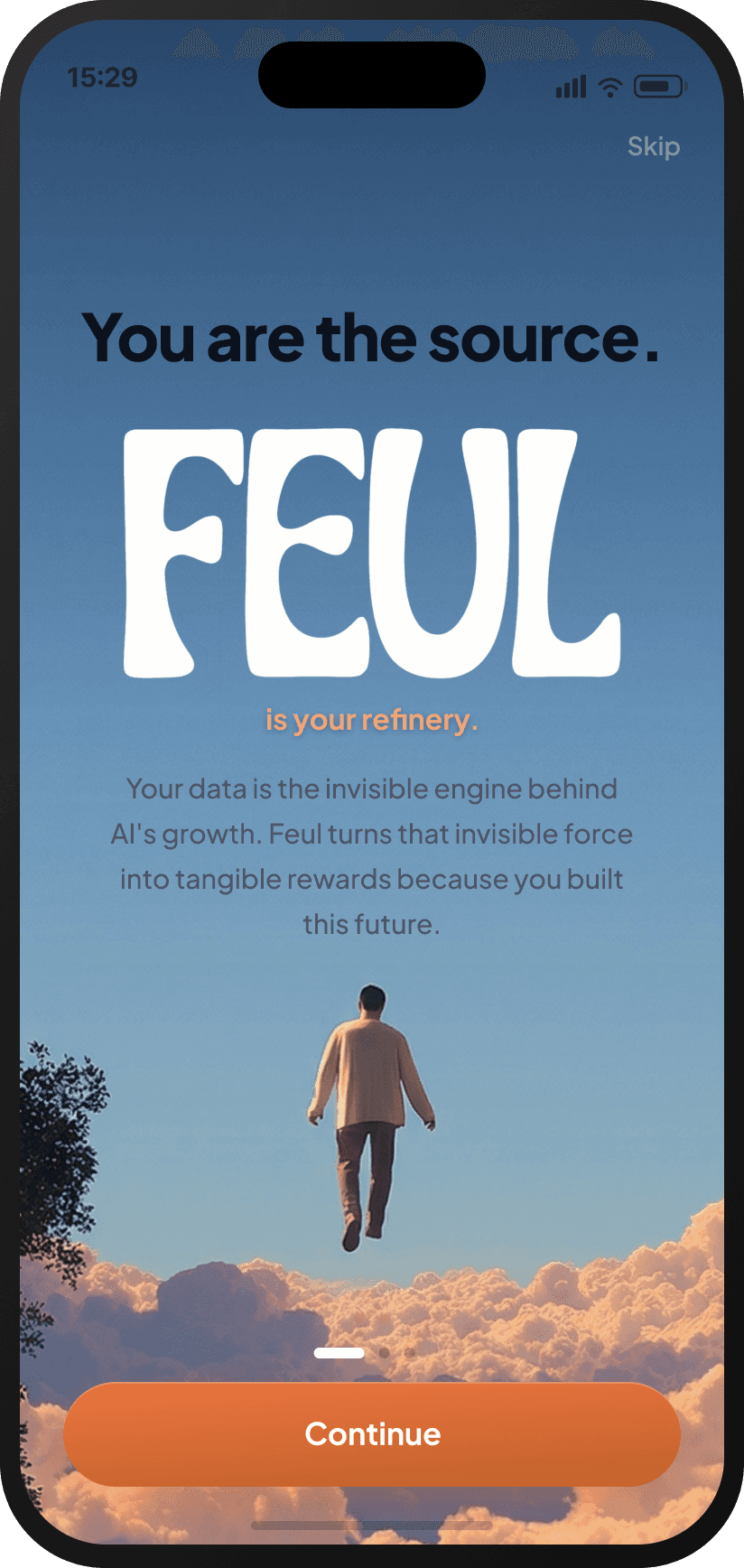
Brand proposition. Sets earning as
the mission.

What they're contributing and why
it matters.
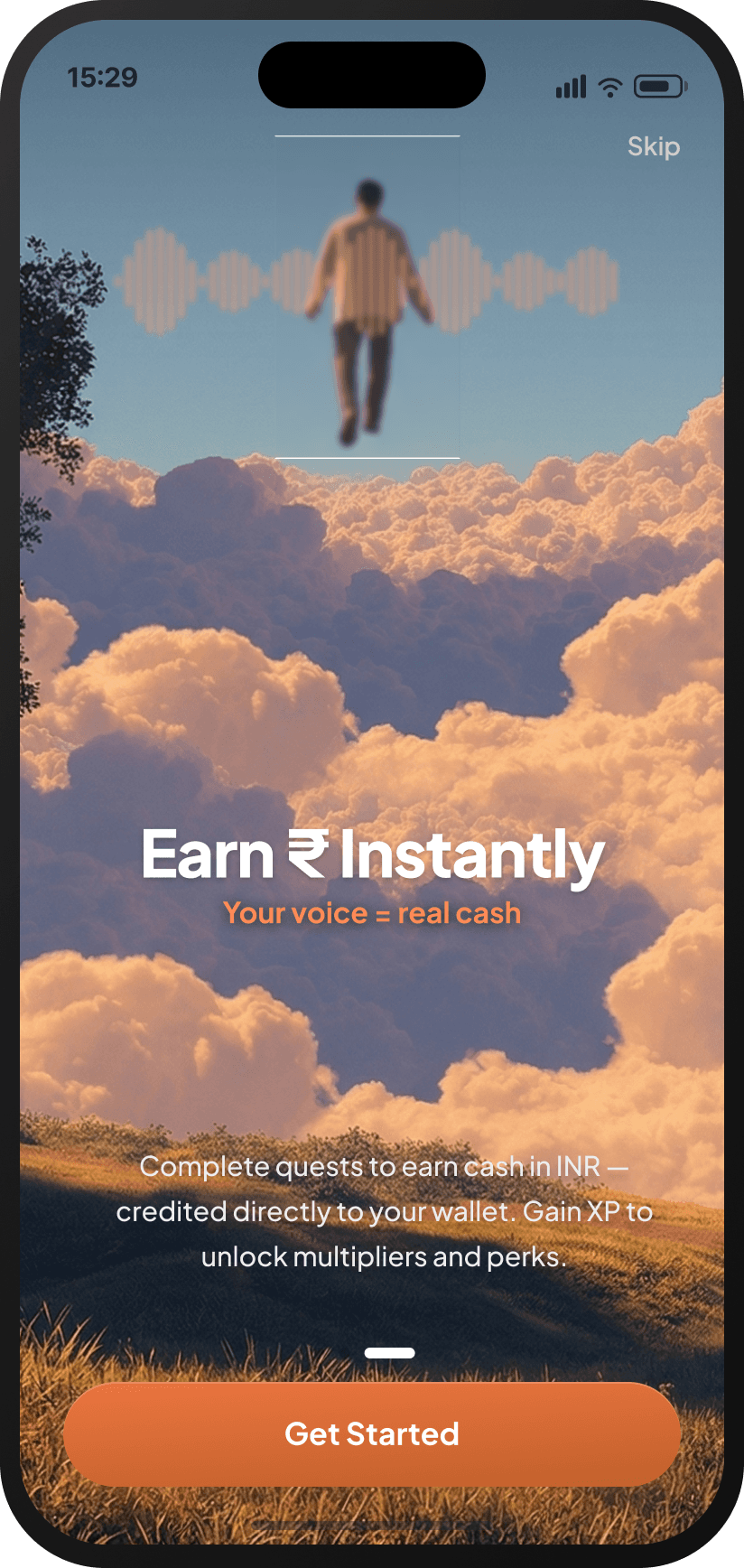
The payout promise. Sets
expectation before they start.
Important before the First Earning Flow
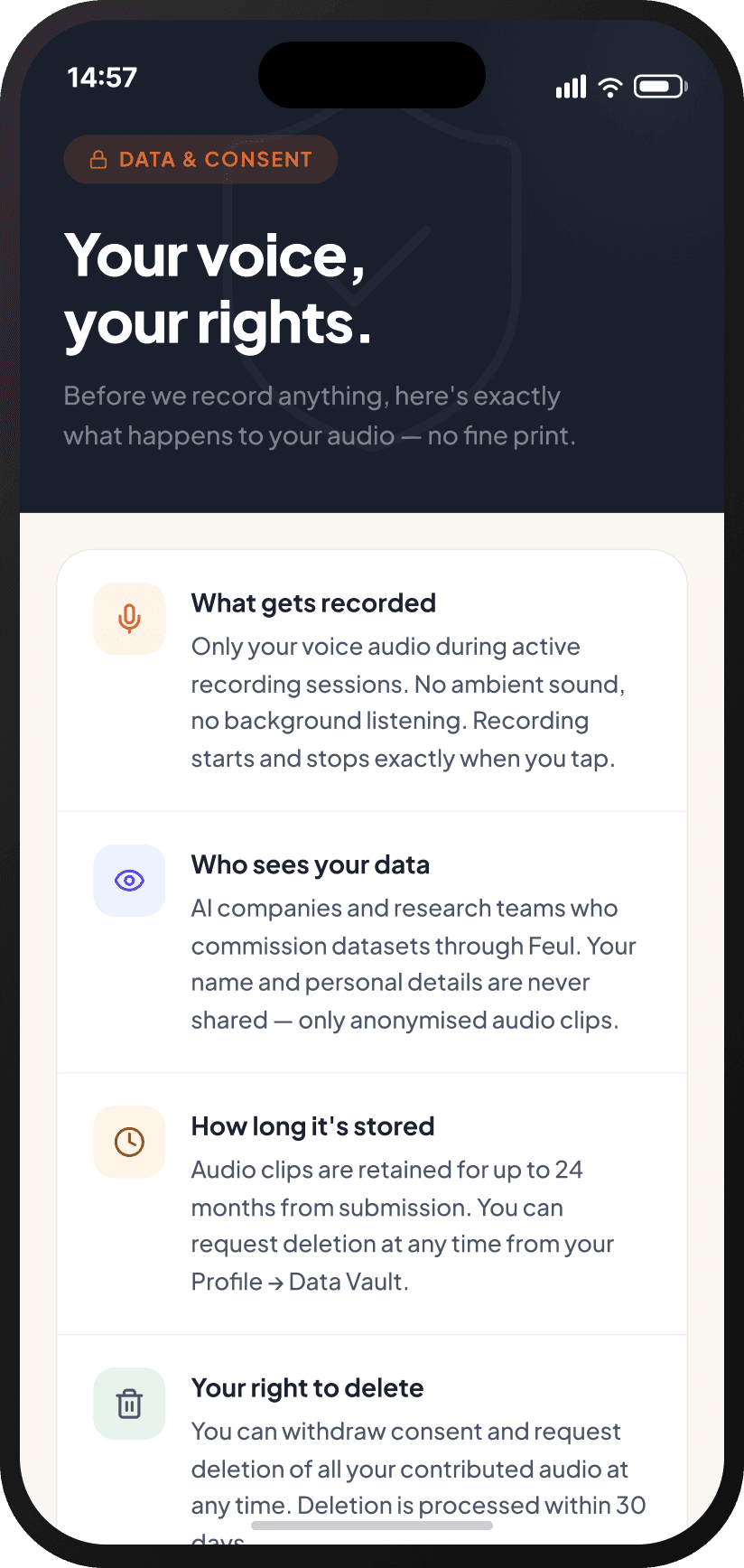
Data Collection Consent Agree
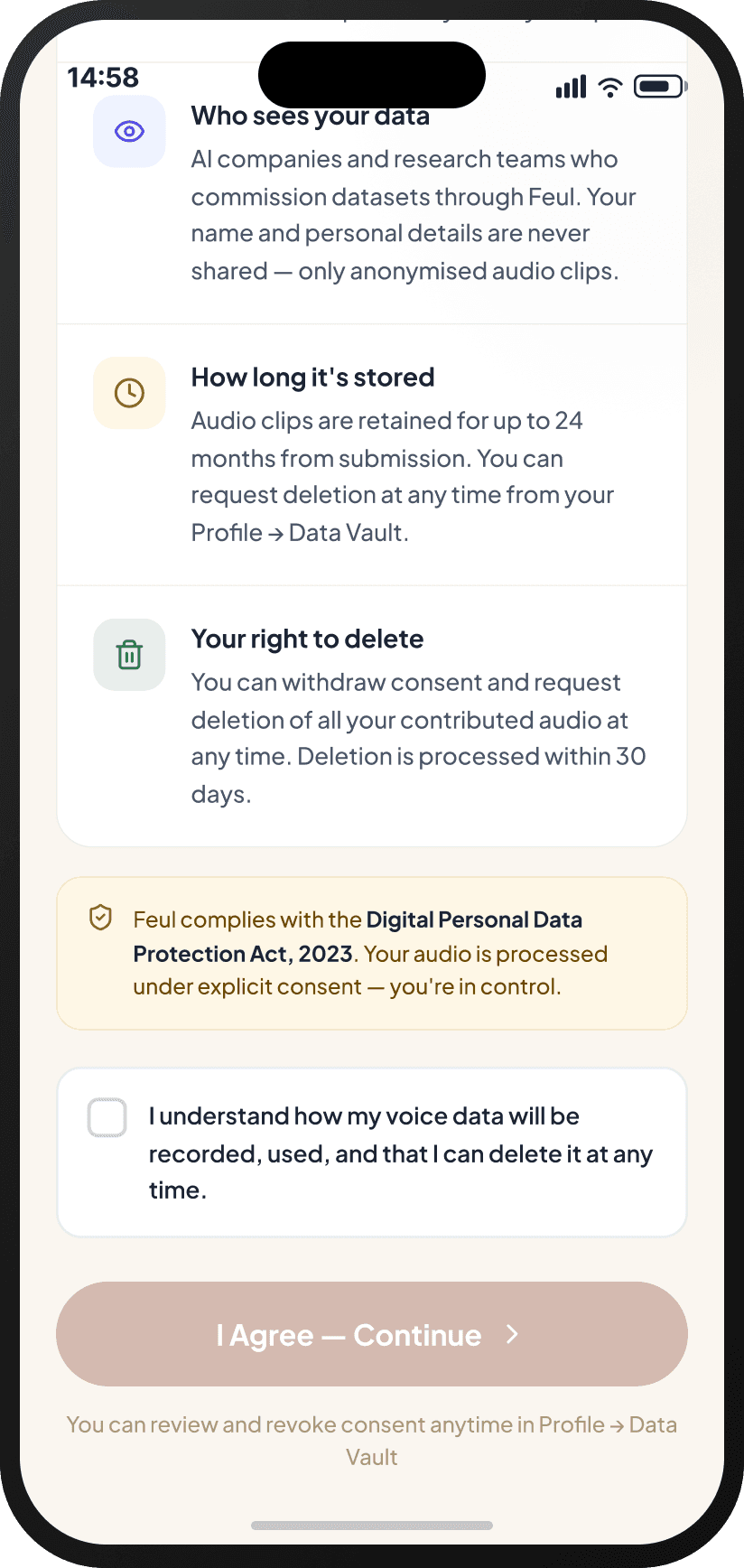
Data Collection Consent
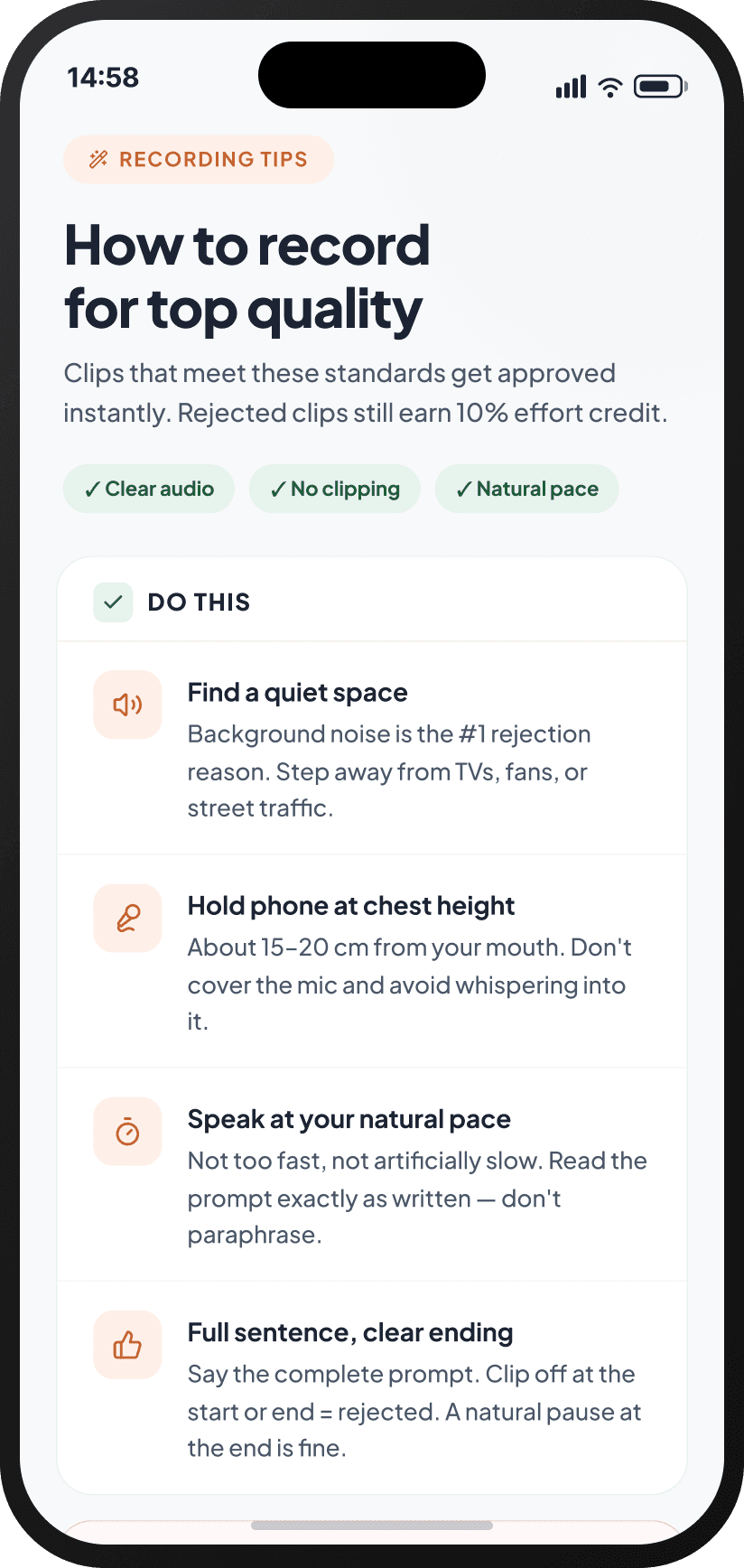
Recording tips
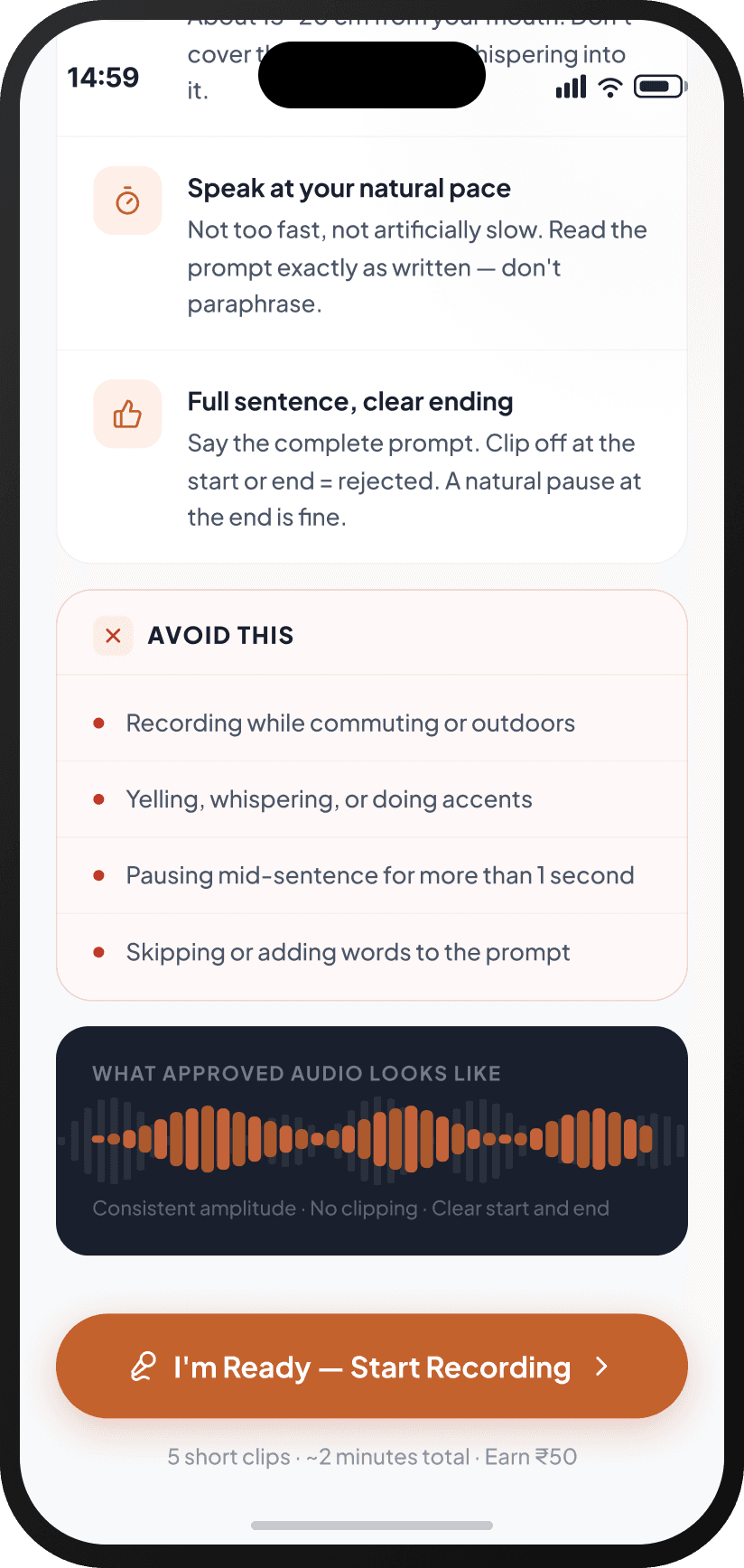
Recording tips
What Feul.AI Is and Who It Serves
Three types of users, one platform — and without contributors there are no
quests, and without quests there are no contributors.
Feul.AI pays Indian gig workers to record short audio tasks — called Quests — for AI training datasets.
Payout per clip depends on the Quest Creator's budget, language rarity, and task complexity. My scope
was the mobile experience for contributors and validators — the earning surface that was not reaching
the gig workforce.
Contributors
The Earner
Students, regional workers, dialect
speakers. Evaluating the platform in
the first session — every interaction
before the first payout is a test of
whether this is real.
Leaves if: pay is obscured, rejection
comes without reason, points show
up instead of rupees
Validators
The Quality Gate
Experienced contributors grading 40
to 50 clips per session. Want
efficiency and clear signal that their
accuracy is being recognized.
Leaves if: grading tool never gets
faster, accuracy drops without
surfacing why
Quest Creators
The Demand Side
AI startups and research labs funding
audio campaigns and receiving
audited datasets. Background
constraint throughout — not the
design focus.
No contributors means no data to sell
— the supply side has to work first
INR wallet from clip one
Earnings accumulate as real rupees from the first
submission. Every entry shows a live status:
Credited, Pending, Effort Credit, Processing. Money
is never in a black box.
First session earns real money
A voice calibration quest on onboarding bypasses
the validation queue and cannot be failed. The first
session ends with ₹50 already showing in the wallet
— proof, not a promise.
Validator accuracy as the lead metric
For validators, accuracy is the first number on screen
— above earnings. The grading interface builds
positional muscle memory after roughly 10 clips. The
tool gets faster with use.
Tiered trust, visible payouts
New contributors see money faster with a lower
threshold. Established ones get higher cash ratios
and priority access. The tier system is visible —
contributors can see what the next level unlocks.
The first earning flow — redesigned so money reaches the wallet before the first session ends:
01
Onboarding
Earning promise
set before first
task begins
02
₹50 hook
"Earn ₹50 in 30
seconds" — the
locked amount
becomes the goal
03
Calibration
quest
Cannot be failed.
Bypasses the
validation queue
entirely
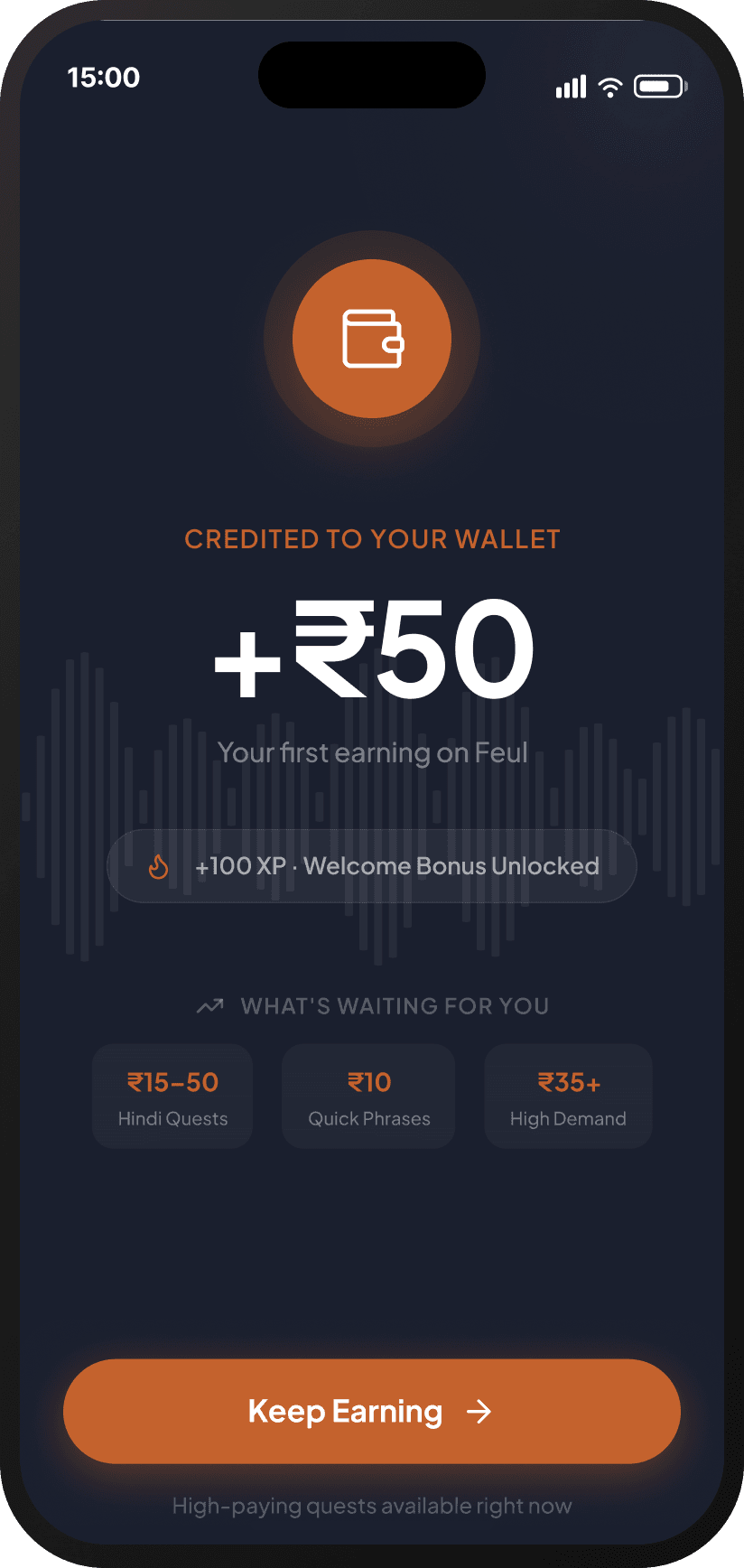
04
₹50 earned
Celebration
screen. Wallet
updates before
home screen
loads
05
Home screen
₹50 showing, next
quest pre-loaded,
streak started
06
Return pull
Expiring bonuses
and streak give
reason to open
tomorrow
First Earning Flow — From hook to ₹ in wallet
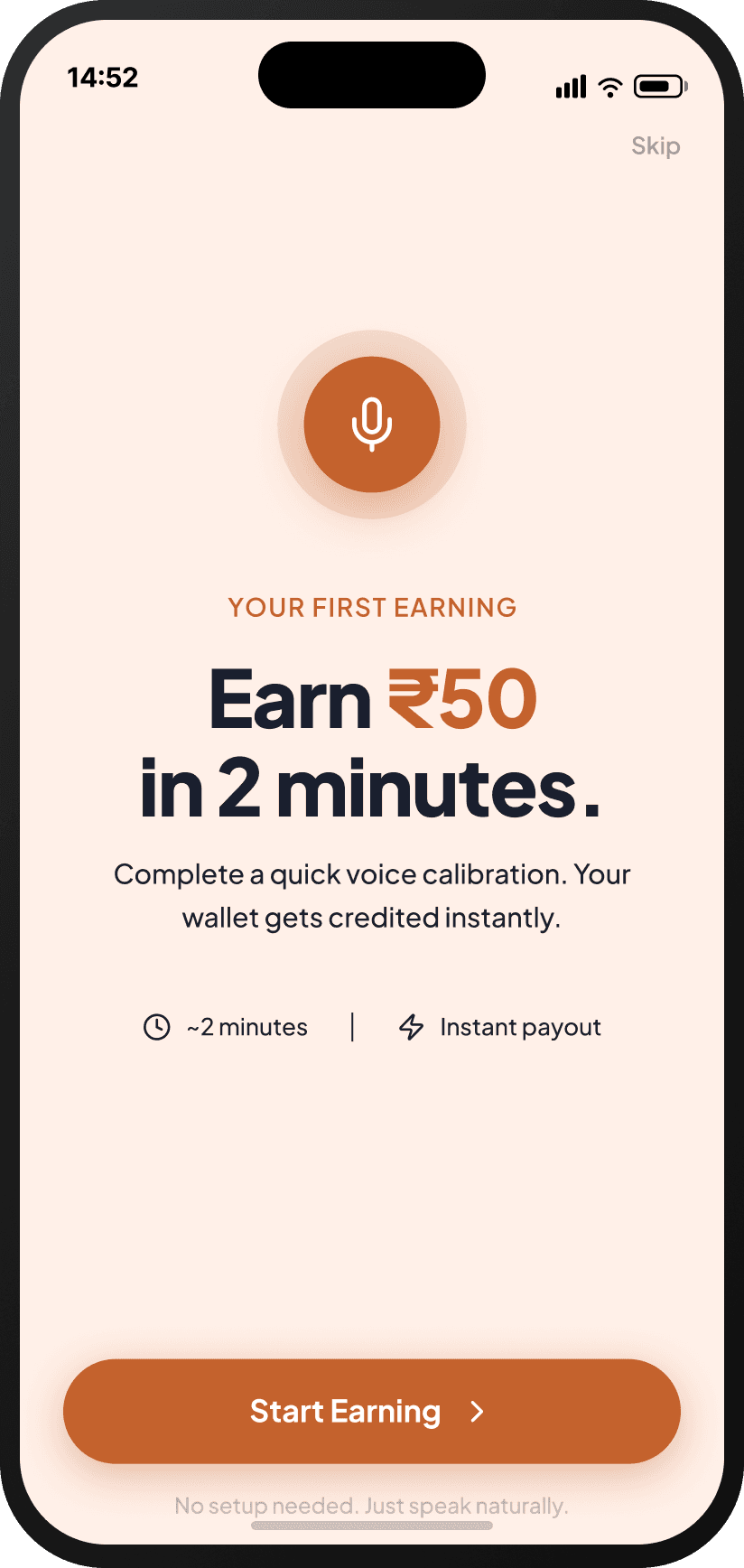
First earning hook. The locked ₹50
becomes the goal.
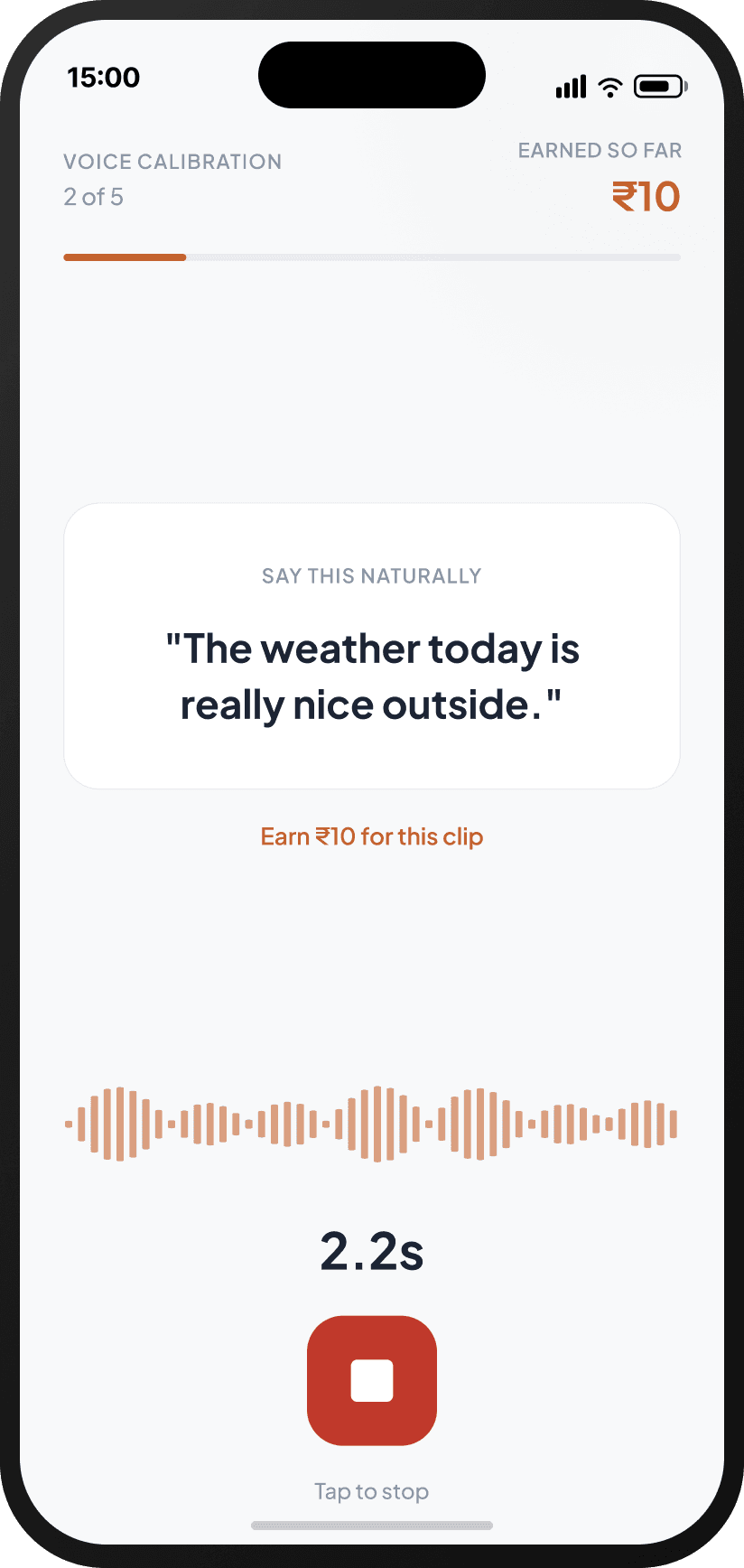
Easy quick audio tasks.
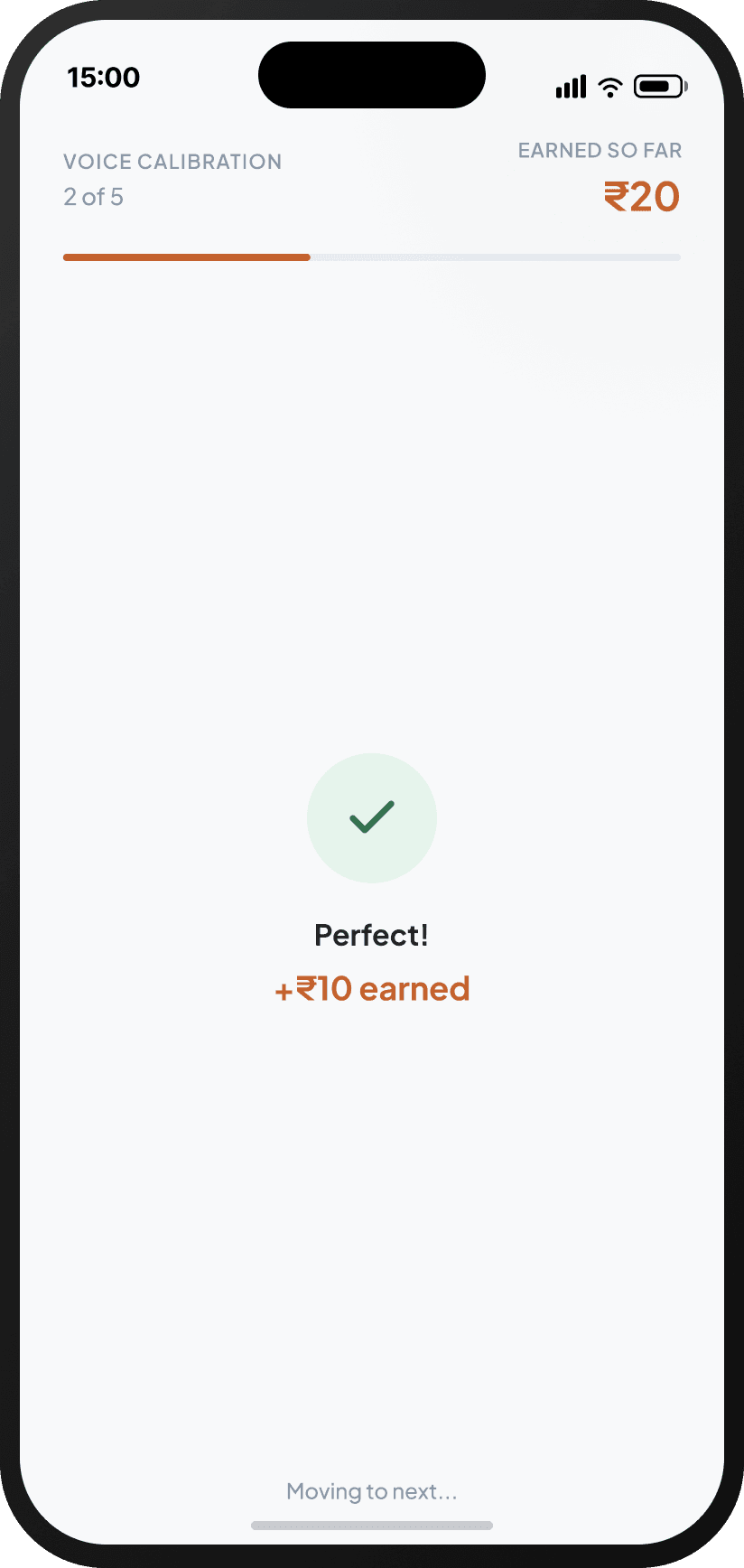
Wallet updated before home
screen loads.
₹50 visible, next quest pre-loaded,
streak counter active.
Solving the Payout Model Before Designing Screens
The founder's initial plan paid in points. Changing this came before any UI
work.
The founder's early product was functional but built around a points-first model — contributors earned
points per clip and converted them to INR above a threshold. The approach was operationally simple
but matched the exact pattern that causes gig workers to quietly drop off: they could not see what their
work was worth in rupees, so they assumed something was wrong.
The reframe I proposed
Founder's plan
Points first, convert to cash later above a threshold. Operationally clean, no upfront
payout complexity.
The finding
Workers don't leave because pay is low. They leave because pay is obscured. They assume
something is wrong, don't complain, and stop opening the app.
The proposal
INR visible from clip one. Wallet as the central UI surface. Rupees always the primary
number, everywhere.
Before designing any screen, I evaluated three payout models to determine which one could actually
support the INR-first principle:
Model A
Direct UPI per clip
Pay the moment a clip is approved. Transparent — but UPI transaction fees
per micro-payment add up fast at scale.
Eliminated
Model B
Points first
Earn points, convert to INR above a threshold. Operationally simpler — but
this is exactly the obscuration pattern that drives drop-off.
Eliminated
Model C
INR wallet
Earnings accumulate as real INR in a platform wallet. Weekly withdrawal
above a threshold. INR visible from clip one. Batch withdrawals keep
transaction costs lower.
Chosen
Model C had one remaining issue: a ₹500 withdrawal threshold creates a retention cliff for new
contributors who complete many clips before seeing any money move. The tier system below solves it
by making the threshold and cash ratio scale with contributor trust level.
Level
Threshold
Cash %
Design intent
Level 1–2 — New
₹50
welcome
bonus
60%
Money in wallet before the first session ends. Platform passes
the trust test immediately.
Level 3–4 —
Established
₹300
85%
Priority quest access and higher-value tasks unlock. Trust
earned — reward it.
Level 5+ — High-
rep
₹500
100%
Clips bypass manual validation — near-instant confirmation.
Full trust, full cash.
The specific thresholds (₹50 / ₹300 / ₹500) are design hypotheses — they need A/B testing against real contributor
activation data before being locked in.
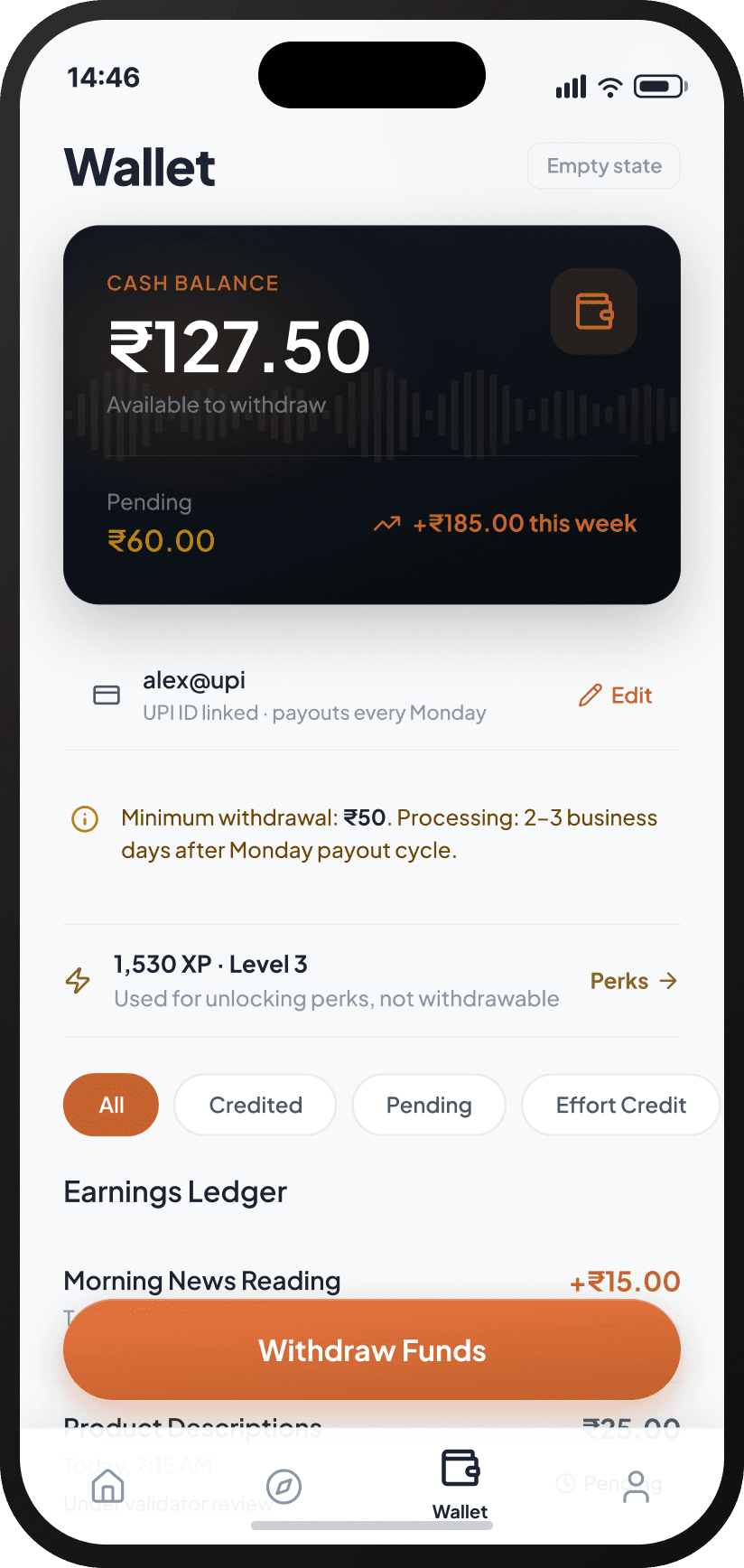
Wallet balance and history
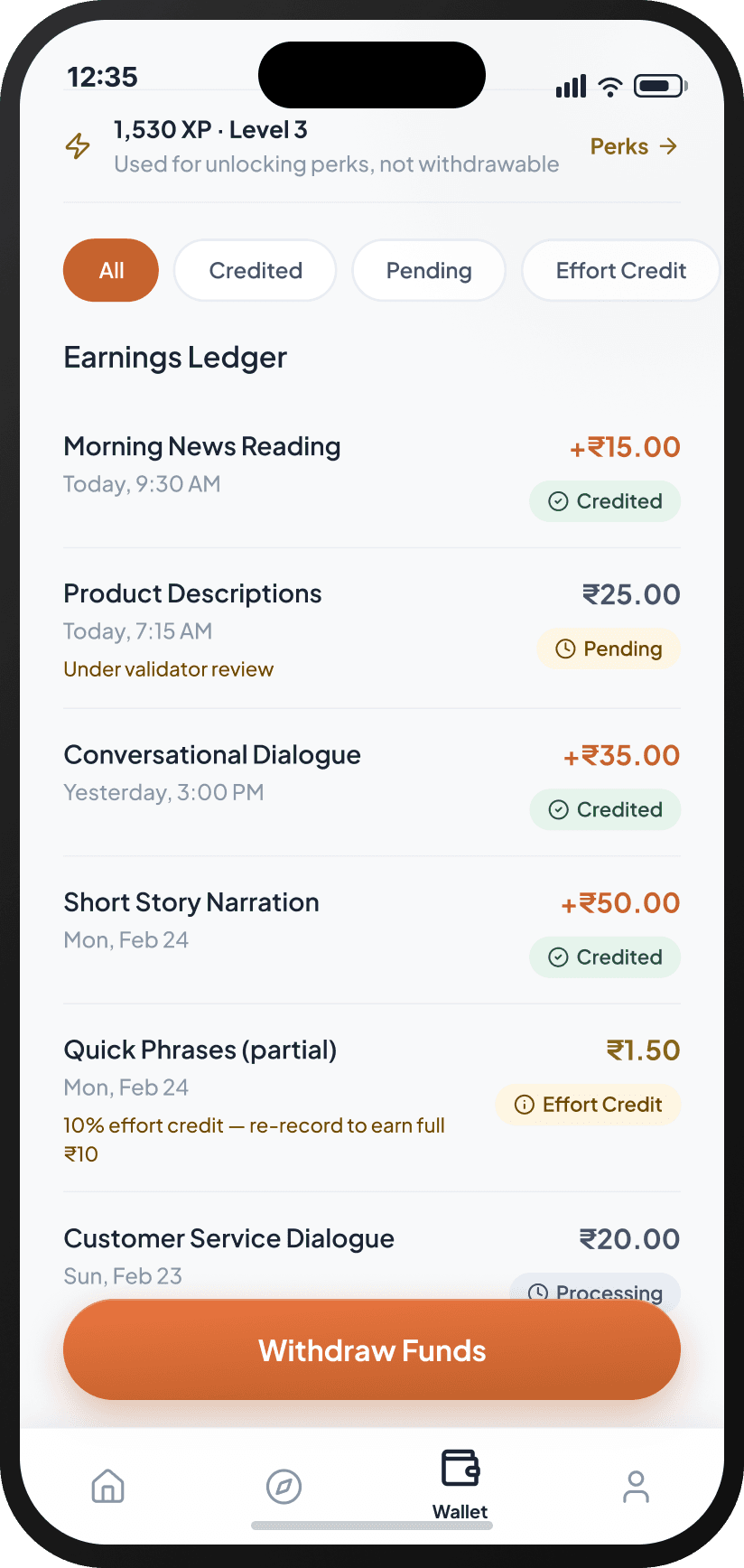
All earnings status
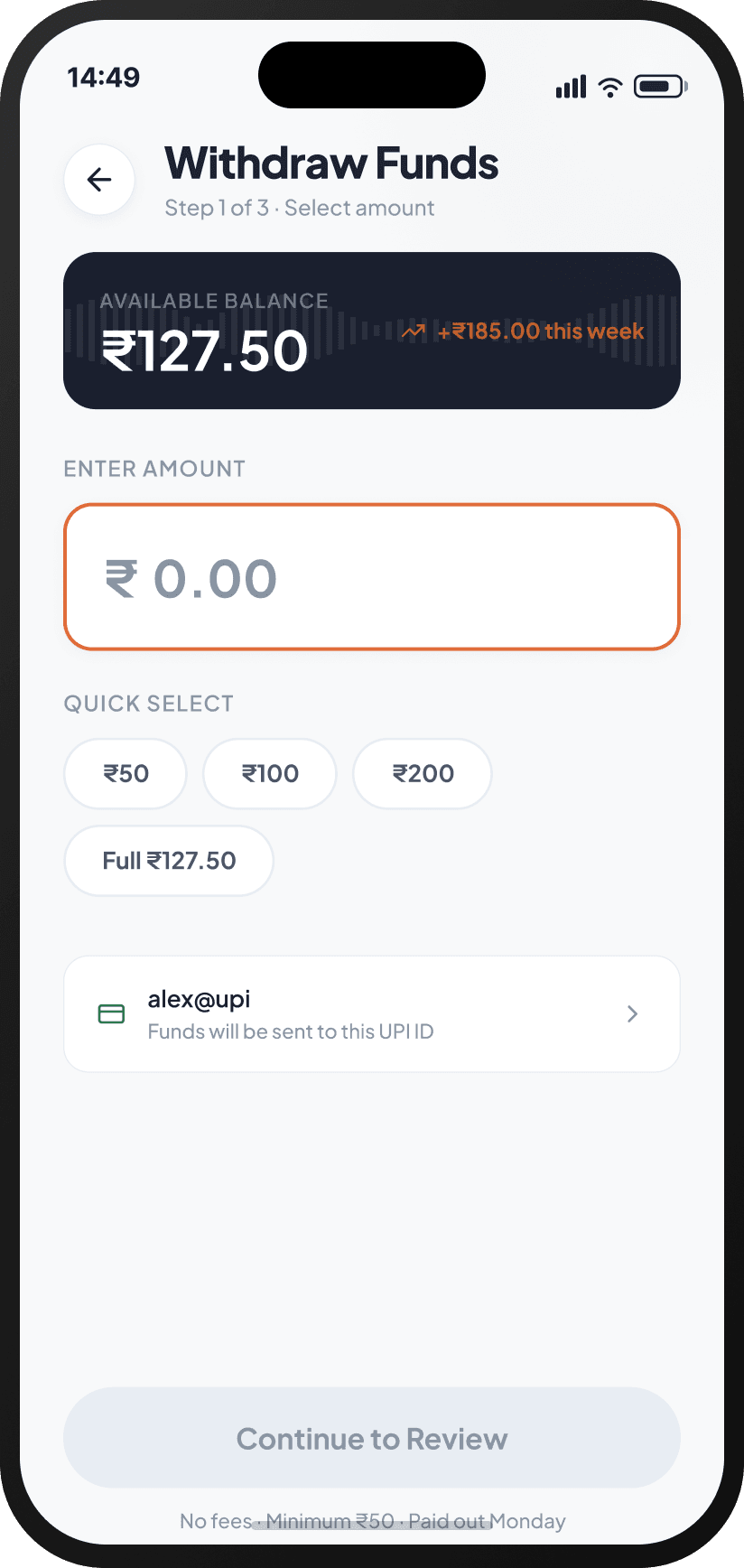
Amount input - 1st step
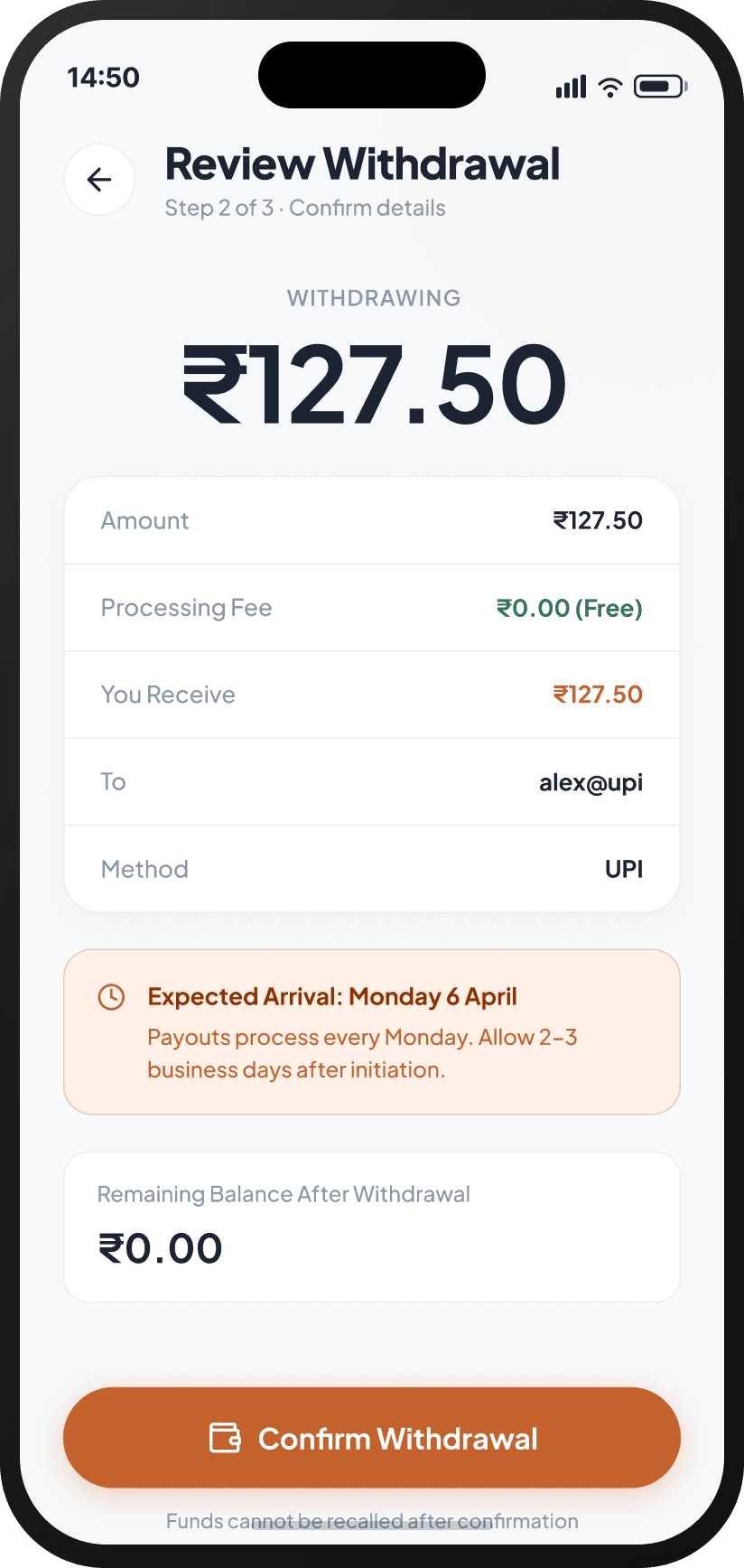
Confirmation - 2nd step
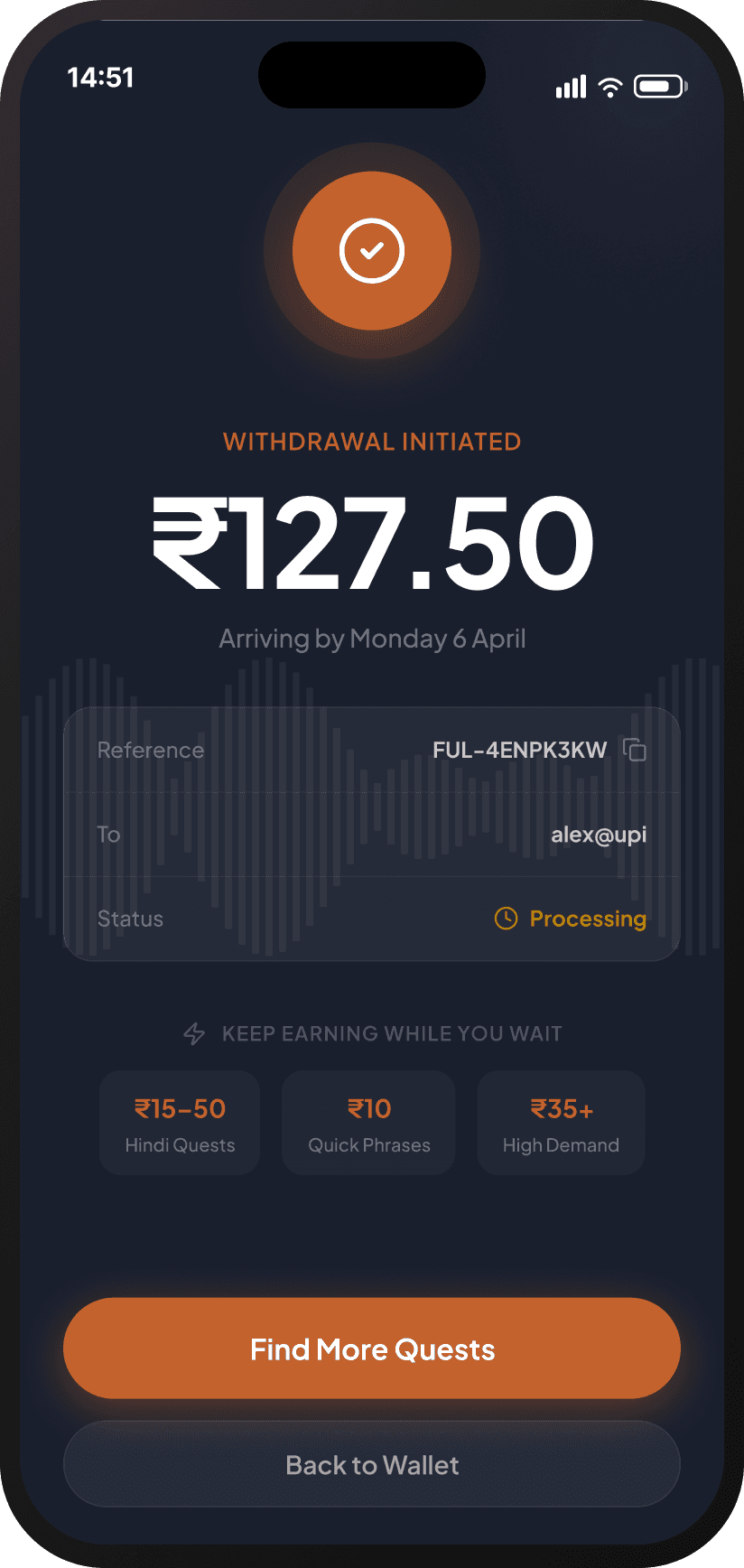
Withdraw Initiated
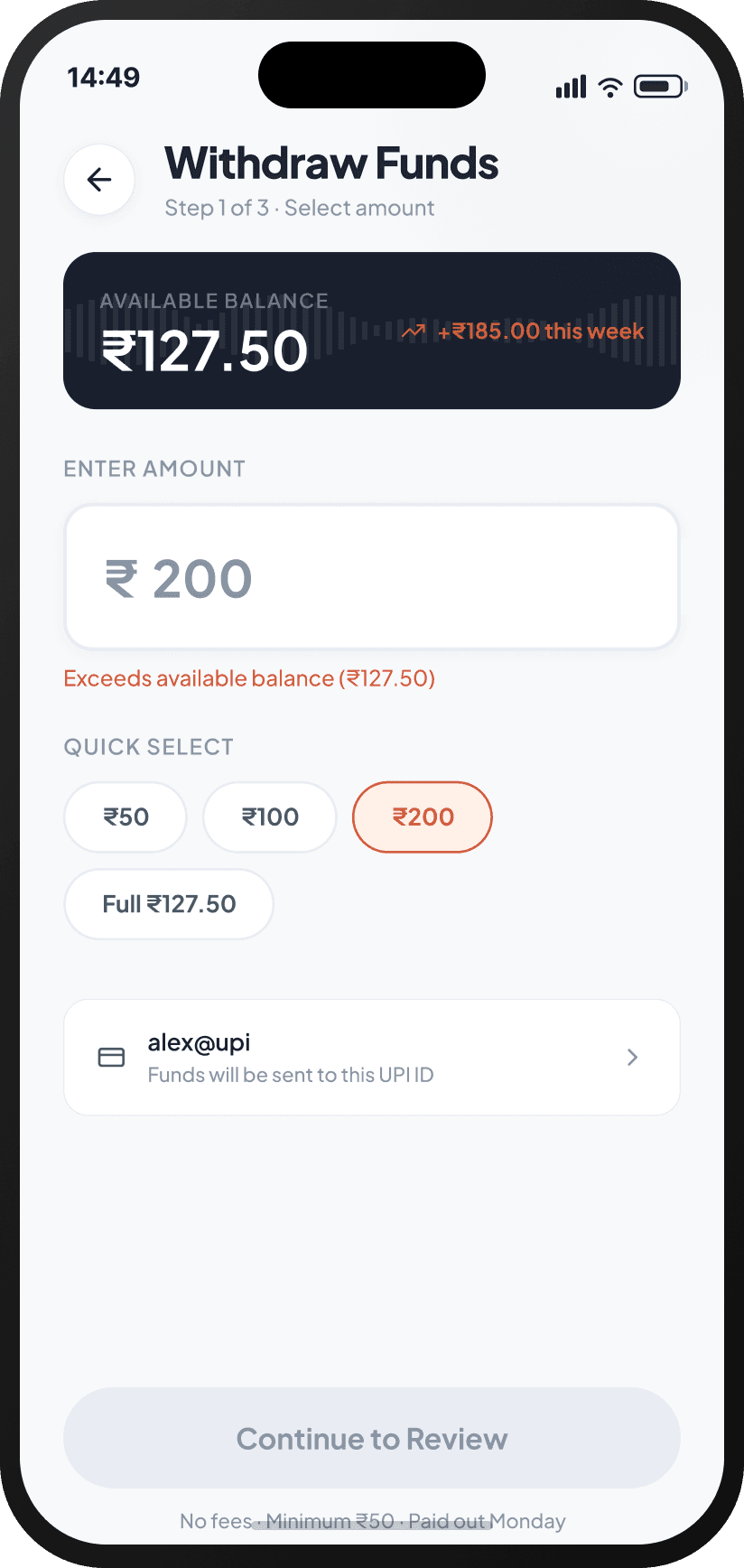
Low Balance withdraw attempt
Key Design Decisions
Three decisions that translated the payout reframe into interface choices.
01
Wallet over rewards
Information architecture
✗ Original structure
Home · Quests · Rewards · Profile. Positions the
platform as a gamification product. Wrong signal for
a worker deciding if it's worth their time.
✓ Final structure
Home · Quests · Wallet · Profile. XP rewards and
voucher redemption moved to Profile under "Perks
and Multipliers," collapsed by default.
Why this mattered
Navigation is the product's first statement about itself. Having Wallet in the navigation over rewards tells contributors that earnings come first — before they have read a single piece of content. Gamification becomes harder to discover as a tradeoff, and that tradeoff is deliberate. The nav sets the relationship between the platform and the contributor before anything else does.
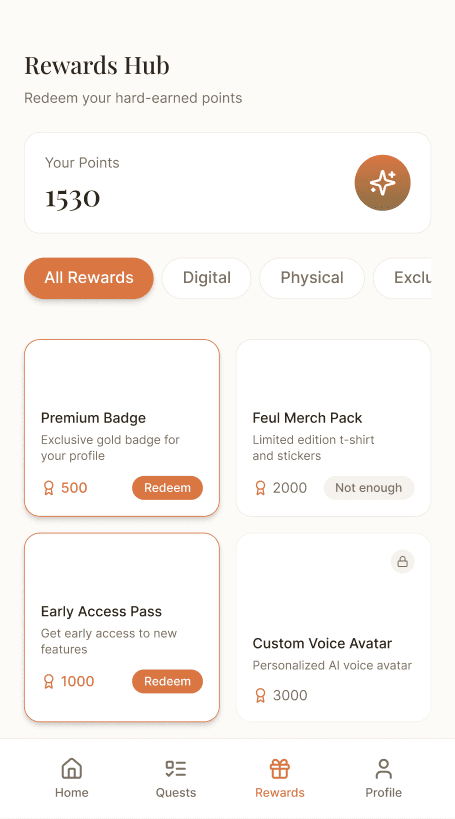
Old Rewards hub
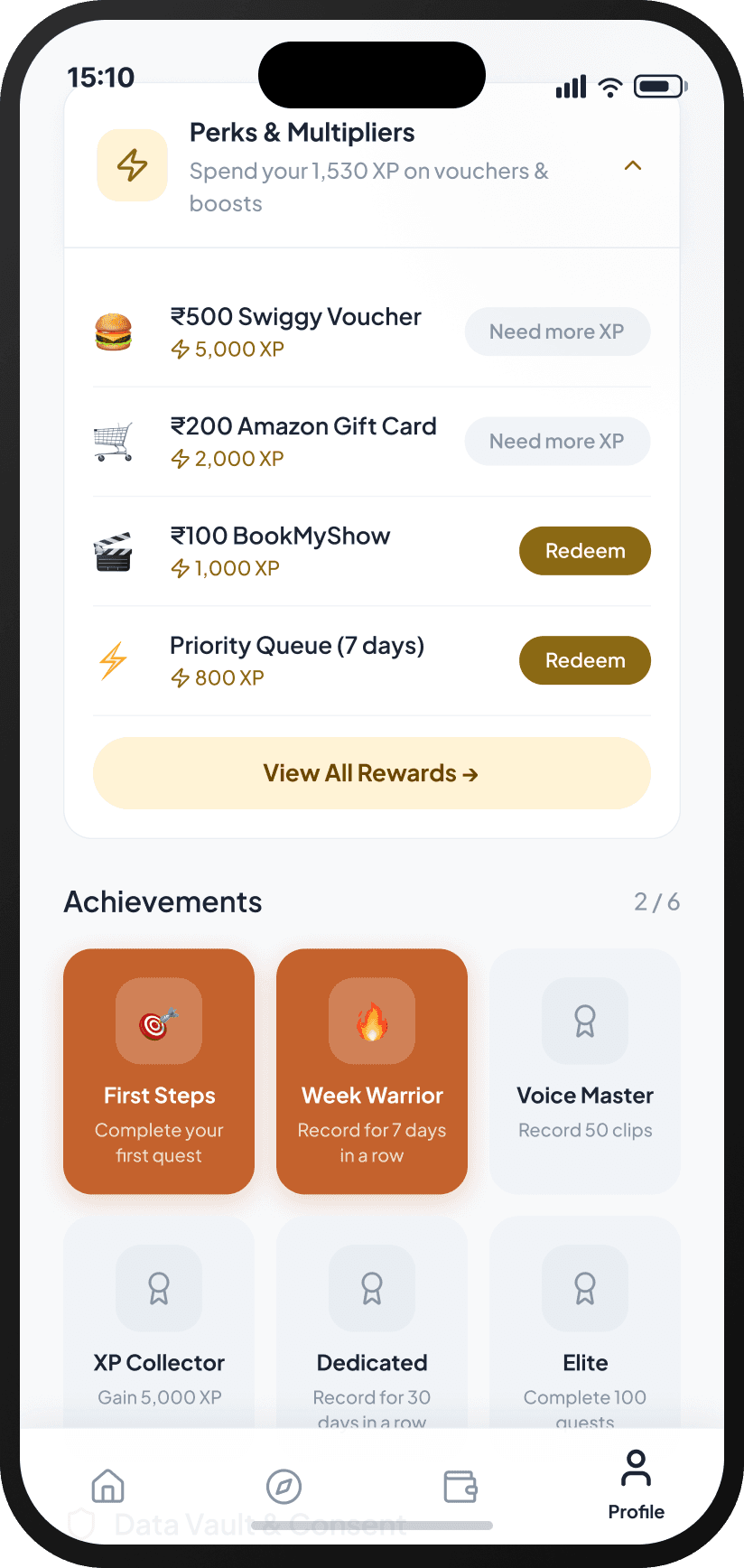
Rewards available through profile
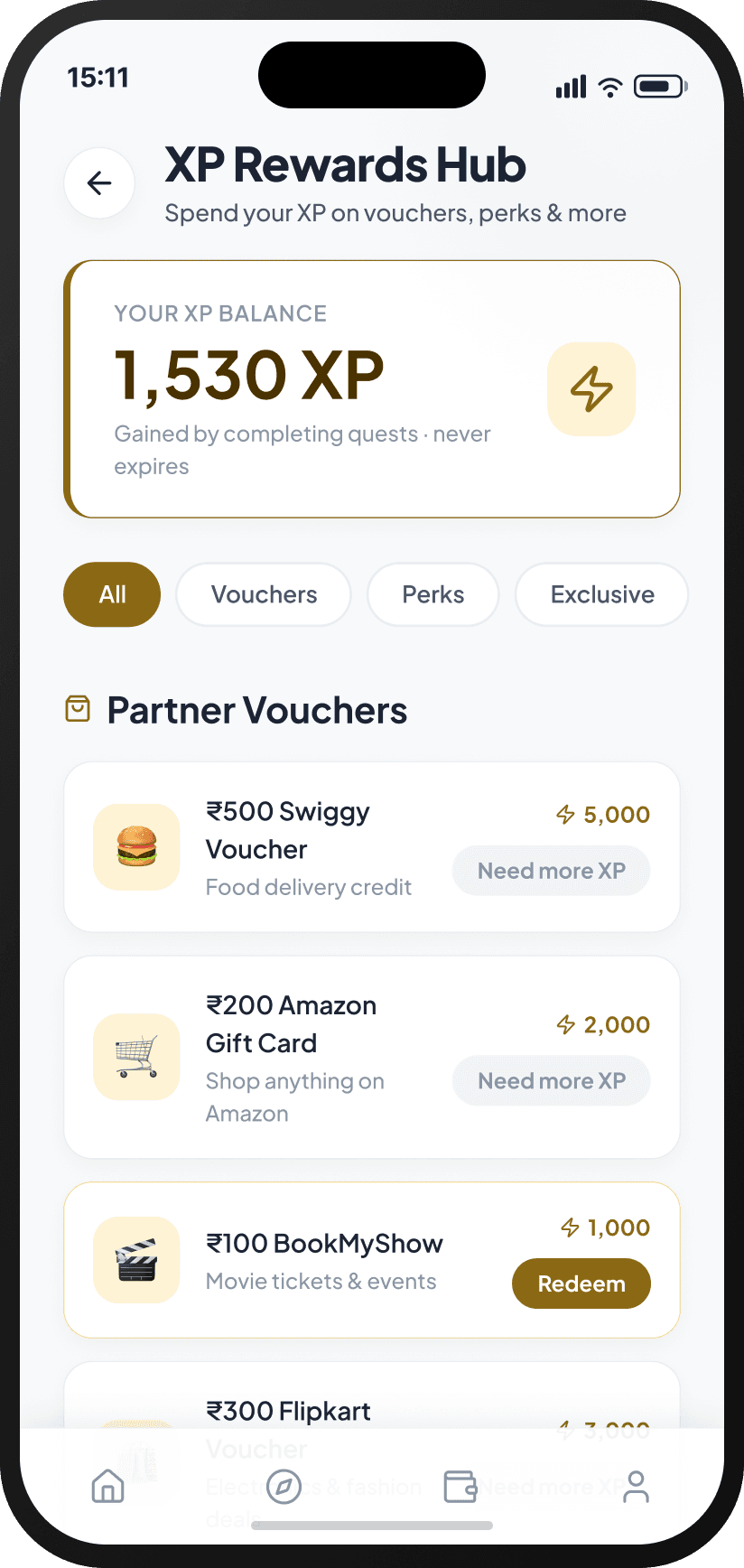
New XP Rewards Hub
Rewards Screens
02
The rupee amount is always the first and largest number shown
Display logic
✗ Original pattern
"⚡ 150 pts (≈ ₹15)" — points as headline, rupees as
footnote. Positions the product as a game first, an
earning platform second.
✓ Final pattern
₹15 in accent green, prominent. +150 XP in muted
text, smaller. Consistent across quest cards, wallet
entries, celebration screen, and onboarding.
Why this mattered
When two numbers are both present, the one shown first and larger is the one that frames the product's
relationship with the contributor. XP motivates return visits — but it should never compete with the rupee amount
for someone deciding whether this is worth their time. Rupees first is a consistent signal at every touchpoint, not
just a display preference.
Old Rewards hub
Rewards available through profile
New XP Rewards Hub
Rewards Screens
03
The first session must end with real money already in the wallet
Onboarding architecture
✗ Original flow
Onboarding, then task list, pick a quest, submit, wait
for validation, get paid eventually. Five potential
drop-off points before any reward reaches the
contributor.
✓ Redesigned flow
"Earn ₹50 in 30 seconds" hook, then a voice
calibration quest that bypasses the validation queue
and cannot be failed. First session ends with ₹50
already showing in the wallet.
Why this mattered
Every interaction before the first payout is a test of whether this platform is real. The calibration quest makes the
platform pass that test in the first session — not the second or third. The ₹50 is not a welcome bonus. It is the
design making a promise and then immediately keeping it. A contributor who earns in session one has a concrete
reason to open the app tomorrow.
Honest Reflection
What are hypotheses. What is a real risk I surfaced rather than leaving
unaddressed.
Numbers I called hypotheses
The tier thresholds (₹50, ₹300, ₹500) and cash ratios
(60%, 85%, 100%) are design assumptions — not
validated numbers. I named them explicitly as
hypotheses requiring A/B testing against real
contributor activation data. Presenting them as
designed precision would be dishonest about the
actual state of the work.
A system risk I flagged
The ₹50 welcome bonus can be gamed by submitting
random audio quickly. I proposed requiring a
minimum number of accepted clips — not just
submitted ones — before the first withdrawal unlocks.
Invisible to honest contributors, but catches obvious
gaming early. I surfaced this rather than leaving it as
an engineering problem.
The wallet shows pending earnings — not just credited ones. Money is never in a
black box. That is the entire design philosophy in one sentence.
The full case study covers the complete earning system
Validator UX and grading interface design, all five design decisions with full
reasoning, the gamification tradeoff analysis, urgency tag design rationale,
the Data Vault privacy feature, all screen walkthroughs, and the complete
design system.
Full case study